
After a typical Berkshire gale, many homeowners find themselves staring at a gap in their garden where a fence panel used to be. It’s a frustratingly common sight in our area, particularly when standard panels aren’t quite up to the task of handling local wind speeds or heavy soil. Deciding on closeboard vs panel fencing bracknell isn’t just about the upfront price; it’s about whether you want to spend your weekends fixing rattling timber or enjoying a secure, private garden that stands the test of time.
We know that you want a sturdy boundary that looks professional and stays standing without needing constant repairs. You shouldn’t have to worry about your privacy or the threat of rot every time the weather turns. In this guide, you’ll discover the critical differences between closeboard and panel fencing to determine which provides the best durability, privacy, and value for your Berkshire property. We’ll look at the structural benefits of each style, how they cope with local ground conditions, and why professional installation with concrete posts is often the best choice whilst enhancing your home’s kerb appeal.
Key Takeaways
- Understand the structural differences between on-site built closeboard and pre-fabricated panels to choose the right foundation for your garden.
- Learn why Bracknell’s specific geography makes closeboard fencing more resilient against the “sail effect” during winter storms.
- Compare closeboard vs panel fencing bracknell to see how the repairability of individual boards can save you money over time.
- Evaluate the long-term value of your investment by calculating the total lifespan rather than just the initial installation cost.
- Discover how professional fitting helps navigate the awkward slopes and varied soil conditions common across Berkshire properties.
Understanding the Basics: Closeboard vs Panel Fencing
Choosing between closeboard vs panel fencing bracknell often comes down to the specific needs of your garden’s layout. While both serve the primary purpose of marking a boundary, they are constructed in entirely different ways. Closeboard fencing is a heavy-duty option built piece-by-piece on-site, whereas panel fencing consists of pre-fabricated sections that are dropped into place. Each has its own place in the local landscape, depending on whether you prioritise structural strength or aesthetic variety.
Closeboard is easily identified by its vertical, overlapping feather edge boards. It creates a solid, continuous run of timber that looks uniform from end to end. Panel fencing offers more variety in design. You can choose from standard lap panels or more intricate decorative styles. Because fences are such a prominent feature of any home, your choice affects more than just privacy; it directly impacts the kerb appeal and perceived value of your property. High-quality boundaries signal to potential buyers that the home has been well-maintained, which is a significant factor in the competitive Berkshire property market.
The Anatomy of Closeboard Fencing
This style is the gold standard for strength. It uses vertical feather edge boards nailed to horizontal arris rails. These rails are secured into sturdy timber or concrete posts. Because we build it on your property, we can adjust the height and angle to follow the contours of uneven ground perfectly. This avoids the “stepping” effect often seen with panels on slopes. A critical component is the gravel board at the base. This sacrificial piece of timber or concrete prevents the main fence boards from touching the damp soil. It’s a simple addition that significantly reduces the risk of rot in Bracknell’s varied soil conditions.
The Versatility of Fence Panels
Fence panels are the traditional choice for many Berkshire estates. They are manufactured in standard 6ft widths and various heights. While basic lap panels are cost-effective, you can also opt for arched or slatted designs to add a modern touch. They are particularly useful if you already have concrete posts in place, as new panels can often be slotted straight into the existing grooves. Understanding different types of fencing helps you decide if you need the structural rigidity of closeboard or the quick, aesthetic flexibility of panels for a level garden boundary. Panels are excellent for quick replacements where the ground is flat and the wind exposure is minimal.
Performance in the Bracknell Climate: Wind and Weather Resistance
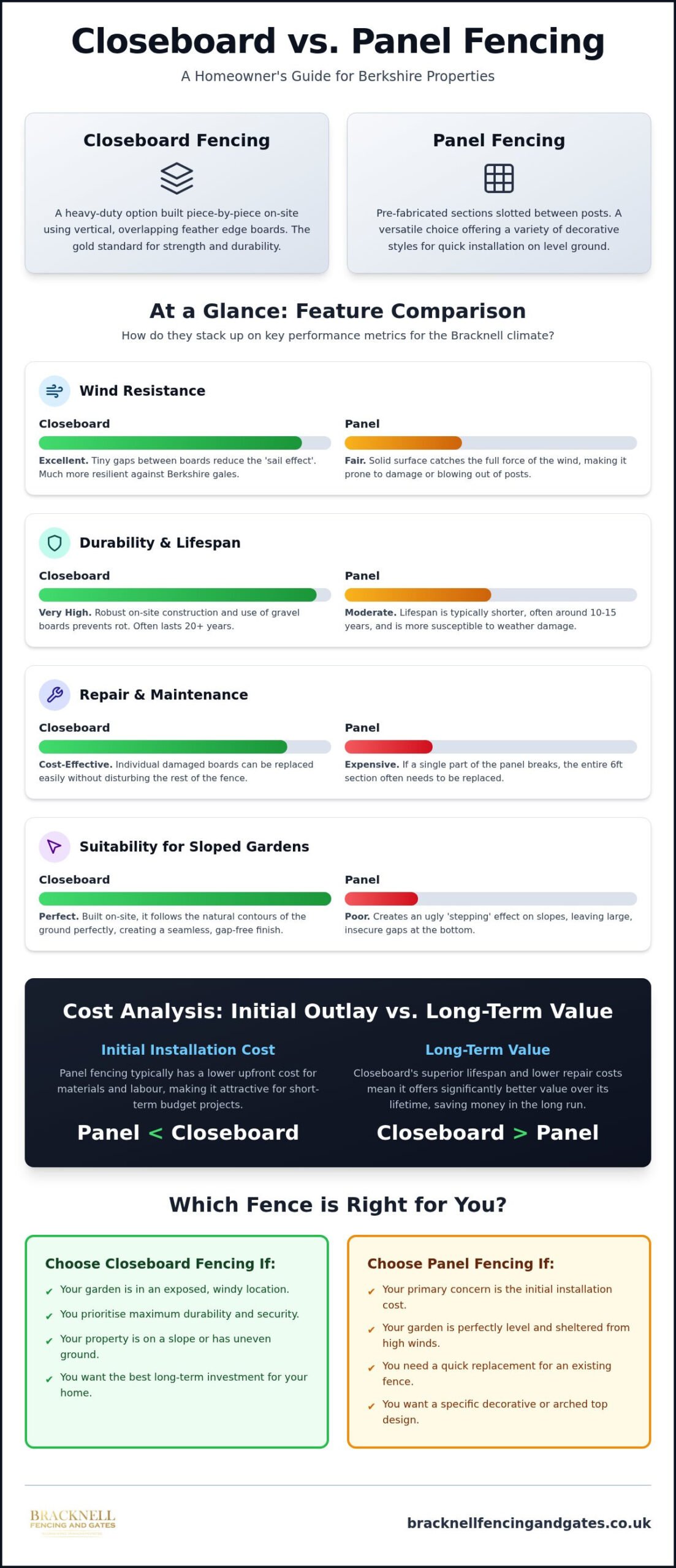
Bracknell’s residential layout often creates unintended “wind tunnels” between houses and garages. This local geography significantly impacts the debate of closeboard vs panel fencing bracknell, as your choice determines whether your boundary stays upright during a winter storm. Standard fence panels often suffer from the “sail effect.” Because they are a solid, flat surface, they catch the full force of the wind. This pressure is transferred directly to the posts and fixings, which is why panels are frequently the first things to blow out or rattle loose in a Berkshire gale.
Closeboard fencing handles these conditions differently. The way the vertical feather edge boards overlap allows for tiny gaps that help air pressure equalise on both sides of the fence. It doesn’t act like a solid sail; instead, it offers a more aerodynamic profile that remains stable when the weather turns. This structural advantage is why many homeowners in more exposed parts of town choose on-site builds over pre-fabricated alternatives.
Structural Integrity Against High Winds
For gardens in exposed areas or on the edges of new estates, closeboard is the superior structural choice. Unlike pre-fabricated panels that can pop out of their grooves, a professional closeboard fencing installation creates a single, integrated unit. The arris rails are notched into the posts, and every board is individually secured. This level of reinforcement makes it incredibly difficult for wind to find a weak point. If you live in a particularly gusty part of town, investing in this structural rigidity provides long-term peace of mind.
Managing Bracknell’s Soil and Drainage
When weighing up closeboard vs panel fencing bracknell, the local soil is just as important as the wind. The ground conditions across Berkshire often involve heavy clay, which retains moisture long after the rain has stopped. This damp environment is the primary enemy of timber. To ensure longevity, we always recommend using concrete gravel boards. These act as a barrier, keeping your wooden boards away from the wet soil. Additionally, the depth of the post is vital. In clay-heavy ground, posts need to be set deep enough to resist the natural heave and shrinkage of the soil. Using timber that has undergone high-quality preservative timber treatment is essential for any wood that remains outdoors. Concrete posts prevent the most common cause of fence failure in Bracknell by eliminating the risk of ground-level rot entirely. If you’re unsure which option suits your specific garden layout, we can provide a fixed-price quote for a durable installation.
Maintenance and Longevity: Which Fence Lasts Longer?
Longevity is a key factor when evaluating closeboard vs panel fencing bracknell. A professionally installed closeboard fence, especially when paired with concrete posts and gravel boards, can last between 20 and 25 years. In contrast, standard lap panels typically have a lifespan of 8 to 12 years. This difference in durability stems from the robust construction of closeboard, which uses thicker timber and a more integrated frame. While the upfront cost is higher, the extended life of the fence often makes it the more economical choice for Berkshire homeowners over two decades.
The British climate is notoriously tough on wood. Constant cycles of wetting and drying can cause cheaper timber to warp or split. This is why we prioritise materials that have undergone thorough treatment processes. For those looking for more detail, this expert guide on garden fencing provides a deeper look at how material choice impacts long-term performance and weather resistance.
The Repairability Factor: Individual Boards vs Full Panels
One of the most overlooked benefits of closeboard fencing is its modular nature. If a single feather edge board is damaged by a stray football or a fallen branch, you can simply replace that individual board for a few pence. It’s a quick, low-cost fix that doesn’t affect the rest of the structure. With panel fencing, the slats are often woven or nailed into a frame that makes individual repairs difficult. Usually, if one part of a panel fails or rots, the entire 6ft section needs replacing. This “all or nothing” approach increases the long-term hassle factor for many Bracknell residents who want a low-maintenance garden.
Treatment and Protection for Maximum Lifespan
Not all timber is treated equally. Dip-treated wood is submerged in a preservative, but the protection often only sits on the surface. We prefer pressure-treated (tanalised) timber, where the preservative is forced deep into the wood fibres under high pressure. This provides much better protection against the fungal decay and insect attacks common in damp Berkshire gardens. To keep your fence in top condition, we recommend a fresh coat of stain or UV-protective oil every few years. If your boundary has already seen better days, you can refer to our expert fence repair services in Bracknell for a professional assessment and restoration to help extend its life.
Cost Analysis: Initial Outlay vs Long-Term Value
Standard panel fencing is often the first choice for homeowners looking for an immediate, budget-friendly boundary. It’s the most affordable way to secure a perimeter quickly. However, the true cost of closeboard vs panel fencing bracknell isn’t just the figure on the first invoice. You have to consider how much that fence will cost you over the next ten or twenty years. Whilst panels are cheaper to buy, they often require more frequent maintenance and earlier replacement, especially after a particularly rough Berkshire winter.
Labour costs also differ significantly between the two styles. Panel fencing is relatively fast to install because the work involves slotting pre-made sections into posts. Closeboard is a more intensive, skilled process. We build the entire structure on-site, board by board. This takes longer but results in a bespoke finish that follows your garden’s unique shape without the awkward gaps or “steps” often seen with pre-fabricated panels.
Budgeting for Your Fencing Project
Beyond the materials, several factors influence the fence installation cost in Bracknell. Ground preparation is a major one. If we’re working with heavy clay or clearing old, overgrown hedges, the labour time increases. There’s also the matter of waste removal. Disposing of an old, rotten fence isn’t always a simple task, but it’s a standard part of our professional service. It’s also important to remember that “cheap” panels can become expensive very quickly if they blow out during the first major storm, leading to emergency repair costs that closeboard owners simply don’t face.
Value for Money: The Case for Closeboard
When comparing closeboard vs panel fencing bracknell, many landlords and long-term homeowners choose the “fit and forget” approach of a closeboard system. Because it’s built to last twice as long as a standard panel, the “price per year” is often much lower. There’s also the impact on your property’s resale value. A sturdy, professional closeboard fence provides excellent kerb appeal. It signals to potential buyers that the property has been well-maintained with high-quality materials. It’s a premium look that standard lap panels struggle to match.
Choosing the right boundary is a balance of immediate budget and future savings. If you’re looking for a definitive price for your garden project, request a fixed-price quote from our local team today.
Professional Installation in Bracknell: Why the Right Fit Matters
Attempting a DIY fence installation in the Berkshire landscape often proves more challenging than many homeowners expect. Bracknell’s heavy clay soil is notoriously difficult to work with, especially during the dry summer months when it hardens or the waterlogged winter when it becomes unstable. Without the right tools and experience, posts are frequently set too shallow. This leads to a fence that leans after the first frost or heave. Professional installation ensures that every post is sunk to the correct depth and secured with the right mix of ballast and cement to withstand the local elements.
When weighing up closeboard vs panel fencing bracknell, the specific layout of your garden is a deciding factor. Professional installers know how to manage awkward corners and steep slopes that would leave a DIY project looking disjointed. We use precise string lines and spirit levels to ensure every section is perfectly aligned. This attention to detail prevents the common sight of wavy fence lines that detract from a property’s appearance. Whether it’s contouring closeboard to a hill or stepping panels accurately, the technical precision of the fit is what guarantees a long-lasting boundary.
Concrete vs Wooden Posts: The Local Verdict
Concrete posts are widely considered the gold standard for local gardens due to the high moisture levels in the ground. Whilst some prefer the traditional look of all-timber construction, concrete won’t rot, snap, or require any ongoing maintenance. You can balance the aesthetics by choosing high-quality timber boards that contrast well with the grey concrete for a clean, modern finish. Using concrete gravel boards is another essential step for any professional fit. They keep the bottom of your fence boards clear of the damp earth, which significantly extends the life of your timber panels by preventing ground-level rot.
Choosing Bracknell Fencing and Gates
We pride ourselves on being a safe pair of hands for any garden project in the Berkshire area. Our team handles the entire process, from the initial site survey to the final tidy-up of your garden once the job is complete. We don’t take shortcuts with post-centring or material quality, ensuring every installation meets our high professional standards. Our goal is to provide a boundary that looks excellent and stands firm for decades, backed by local expertise you can trust. If you’re ready to upgrade your garden boundary, contact us today for a bespoke fencing solution and a fixed-price quote tailored to your specific needs.
Secure Your Berkshire Garden for the Long Term
Deciding on closeboard vs panel fencing bracknell depends on whether you prioritise immediate savings or long-term structural integrity. Closeboard fencing offers unmatched durability against Berkshire’s winter gales, whilst panels provide a versatile and cost-effective entry point for level gardens. By choosing premium materials like pressure-treated timber and concrete gravel boards, you ensure your boundary remains a stable and attractive feature for years to come. Investing in the right structure today prevents the frustration of emergency repairs tomorrow.
As local Bracknell specialists, we focus on providing storm-resistant installations that handle our unique soil conditions. We don’t believe in shortcuts; we believe in craftsmanship that offers genuine peace of mind. Every project we undertake is built to professional standards, ensuring your garden stays private and secure regardless of the weather. If you’re ready to upgrade your garden with a boundary that’s built to last, Get a Professional Fencing Quote from Bracknell Fencing and Gates today. We’re here to help you create a secure, private space that you can enjoy in every season.
Frequently Asked Questions
Is closeboard fencing better than panel fencing for privacy?
Closeboard fencing provides a superior level of privacy because it’s constructed as a continuous run of overlapping boards. Unlike pre-fabricated panels, there are no frames or gaps between sections where people might peek through. Because we build it on-site, we can ensure the fence follows the ground levels perfectly, eliminating any gaps at the bottom. This makes it an ideal choice for overlooked gardens in residential estates across Berkshire.
How much more expensive is closeboard fencing compared to panels?
Closeboard fencing typically requires a higher initial investment than standard panel fencing due to the increased timber volume and the skilled labour involved in on-site construction. However, when comparing closeboard vs panel fencing bracknell, you should consider the total lifespan. A closeboard structure often lasts twice as long as a basic lap panel. This longevity means you won’t be paying for a full replacement again in ten years, offering better value.
What is the best fence for a windy garden in Bracknell?
Closeboard is the most reliable option for gardens exposed to high winds. Its design allows small amounts of air to pass through the overlapping boards, which helps equalise pressure. Standard panels act like a sail, catching the wind and putting immense strain on the posts. For homes on the edge of new developments or in open areas of Bracknell Forest, a sturdy closeboard installation provides the best protection against storm damage.
How long does a closeboard fence last in the UK climate?
A well-maintained closeboard fence installed with concrete posts and gravel boards can last between 20 and 25 years. The use of pressure-treated timber is essential for resisting rot in our damp climate. In contrast, standard fence panels often need replacing after 8 to 12 years. Regular applications of a quality wood preservative or UV-protective oil will help your timber stay strong and look its best for decades to come.
Can I use my existing posts if I switch from panels to closeboard?
It’s usually not possible to reuse existing posts when switching from panels to closeboard. Standard panel posts have grooves designed for 6ft sections to slide into, whereas closeboard requires specific posts that can support horizontal arris rails. If you have sturdy concrete posts already, you might be better off choosing high-quality feather edge panels. For a true closeboard build, we typically install new, dedicated posts to ensure structural integrity.
Do I need a gravel board for my new fence in Bracknell?
We strongly recommend using gravel boards for every new installation in Bracknell. They act as a sacrificial barrier between the main fence boards and the damp, clay-heavy soil. By keeping the timber off the ground, you prevent the bottom of the fence from soaking up moisture and rotting prematurely. Concrete gravel boards are the gold standard here, as they won’t rot and provide a solid base that lasts as long as the posts.
Which side of the fence is my responsibility in Bracknell?
There’s no universal rule about which side of a boundary is yours; it depends entirely on your property’s deeds. You should check your house plans or the Land Registry for “T” marks on the boundary lines. A “T” on your side indicates that the fence is your responsibility. If you’re unsure, it’s always best to have a friendly chat with your neighbour before starting any work on a shared boundary.
How long does it take to install a new fence professionally?
Most professional fencing projects in the local area take between two and three days to complete. This timeframe includes the removal of your old fence, digging the post holes, and the physical construction of the new boundary. Larger gardens or those with difficult access and heavy overgrowth may take slightly longer. We always provide a clear schedule during our initial survey so you know exactly when your garden will be secure again.