
Imagine waking up after a restless night of howling gales only to find your garden boundary flat on the grass. For many homeowners across Berkshire, this isn’t just a one-off event; it’s an expensive annual tradition that leaves your property exposed and your privacy gone. It’s exhausting to keep paying for repairs every time the British weather decides to test your garden’s limits.
You deserve a boundary that stands its ground. Finding the most durable fencing for wind is about more than just buying thicker timber. It’s about understanding how airflow works and ensuring your foundations are built to last. Whether you’re tired of flimsy overlap panels or you’re planning a fresh installation, we’ll show you how to build a resilient barrier that offers peace of mind for ten years or more.
In this guide, we explore why heavy-duty closeboard fencing and feather edge panels outperform standard options. We will also explain the vital role of concrete posts and the specific installation techniques that turn a simple fence into a storm-proof investment for your home.
Key Takeaways
- Understand how the “sail effect” causes solid panels to collapse and why aerodynamic designs with subtle gaps are more resilient.
- Identify why closeboard and feather edge are the most effective styles of durable fencing for wind compared to budget alternatives.
- Learn the importance of the “2ft foundation rule” to keep your posts anchored securely in Berkshire’s clay-heavy soil.
- Compare the long-term benefits of concrete posts and gravel boards to prevent the common issue of ground-level timber rot.
- Discover how professional installation techniques can extend the life of your garden boundary by ten years or more.
Why British Storms Topple Standard Garden Fencing
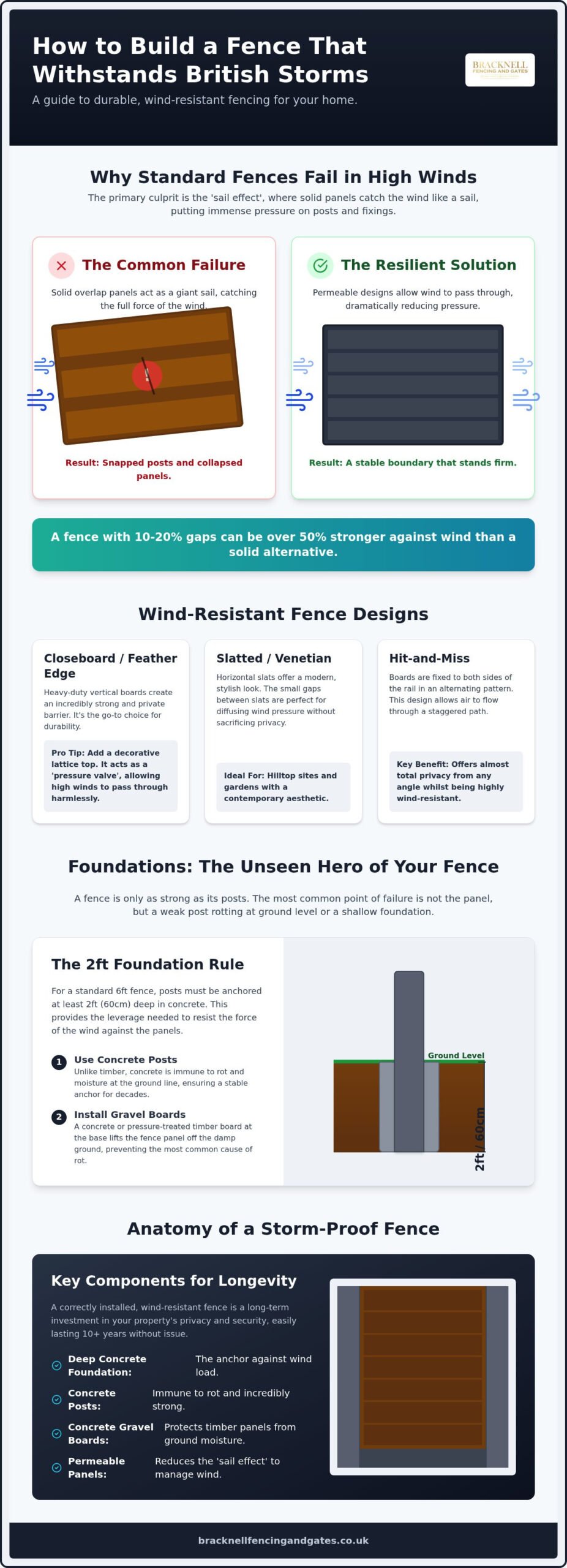
Most garden boundaries in Berkshire fail because they weren’t designed to handle significant air pressure. Choosing durable fencing for wind starts with understanding why standard panels fail during a typical British storm. The most common culprit is the “sail effect.” This happens when solid panels, like budget overlap styles, act as a giant sail. Because the wind cannot pass through the timber, it exerts massive force against the surface. This pressure eventually snaps the fixings or pulls the posts straight out of the ground.
Cheap overlap panels are often a false economy in exposed areas. These panels are constructed from thin slats that lack structural rigidity. In a high-wind event, the timber flexes until it cracks. Our local geography makes this worse. Many parts of Berkshire feature open fields and flat landscapes where wind velocity increases without obstruction. If your home sits on the edge of a valley or near open green space in Bracknell, your fence faces much higher stress than a sheltered town garden.
The Mechanics of Wind Pressure on Boundaries
Wind load is the force exerted on a vertical surface. It’s a calculation of surface area against wind speed. A 6ft fence is far more vulnerable than a 4ft alternative because the extra height acts as a longer lever against the foundations. The taller the fence, the more force it applies to the base of the post. Scientific studies on the aerodynamics of permeable fences demonstrate that even small gaps can significantly reduce this pressure. By allowing some air to filter through, you break the vacuum and prevent the “sail effect” from toppling the structure.
Identifying Weak Points in Your Current Fence
The most frequent failure point is the ground line. This is where timber posts are most susceptible to rot. Moisture stays trapped against the wood, softening the fibres until they can no longer support the weight of the panel. You can check for this by testing the “wobble” of your posts. If there is movement at the base or if you see hairline cracks in the timber, the structure is compromised. Using professional fence repair services Bracknell can help you identify these issues before a storm turns a small crack into a total collapse. Investing in durable fencing for wind means addressing these foundations before the winter weather arrives.
The Best Wind-Resistant Fence Designs: Aerodynamics Explained
Choosing the right style is the most effective way to ensure your boundary survives a gale. It’s a common misconception that a solid fence is the strongest option. In reality, a fence with 10-20% gaps is often 50% stronger than a solid alternative because it doesn’t try to stop the wind entirely. By breaking the wind’s force, you reduce the physical stress on the posts and panels. This approach is essential for anyone looking for durable fencing for wind in exposed Berkshire locations. Engineering standards for fence design and code requirements highlight that wind load is the primary cause of structural failure in residential boundaries, and managing this load is key to longevity.
Slatted and Venetian Fencing: Style with Airflow
Venetian or slatted fencing is a top choice for modern aesthetics. The horizontal slats create shadow gaps that look great whilst providing a high level of privacy. Because the air flows through these narrow gaps, the panel remains stable even during intense gusts. This makes slatted designs particularly effective for hilltop sites amongst the Berkshire downs. The gap size can be customised to balance your specific privacy needs with the local wind conditions, ensuring you don’t sacrifice security for stability.
Hit-and-Miss Fencing: Privacy Without the Pressure
Hit-and-miss fencing uses a paled construction where boards are fixed to both sides of the rail in an alternating pattern. This creates a staggered path for the air. It’s an excellent solution for wind-heavy corridors between houses. It offers total privacy from a direct angle but allows the garden to “breathe” during a storm. Whilst these panels are incredibly durable, they do require thorough treatment on both sides to ensure the internal boards remain protected from the elements over time.
For those who prefer the traditional look of Closeboard Fencing, adding a decorative lattice top can serve a practical purpose. These trellis sections act as pressure valves, allowing the highest and fastest wind to pass through the top of the fence rather than pushing against the main body. If you aren’t sure which style suits your garden’s layout, our team can help you select a wind-resistant boundary solution that matches your home’s style and provides peace of mind for years to come.
Comparing Heavy-Duty Materials for Maximum Longevity
Material selection is the second pillar of creating a boundary that survives the British winter. Whilst the design dictates how air moves, the material determines how well the structure absorbs physical stress. Vertical board fencing is inherently stronger than horizontal alternatives. Because the boards overlap and are secured to thick arris rails, they create a dense, rigid barrier. This setup is far less likely to “pop” out of a frame during a gale. High-quality fixings are equally vital. Using stainless steel nails prevents the “nail sickness” that causes boards to loosen as the metal corrodes. Investing in the right materials ensures you have truly durable fencing for wind that won’t require constant attention.
Closeboard Fencing: The Heavyweight Traditional Choice
A closeboard fencing installation remains the gold standard for Berkshire homeowners. Unlike pre-made panels that are often held together with thin staples, closeboard is constructed on-site from individual feather edge boards. Each board is nailed directly to a sturdy framework of horizontal rails. This bespoke approach allows us to reinforce the structure for extra-windy sites. We can add a third arris rail or reduce the spacing between posts to increase lateral strength. The sheer weight and density of closeboard make it incredibly difficult for wind to shift or damage.
Composite Fencing: Modern Durability and Flex
Composite fencing provides a modern alternative with unique advantages. These panels are manufactured from a blend of recycled wood fibres and polymers, making them completely resistant to rot and insect damage. One of the most useful traits during a storm is “flex.” Composite materials can bend slightly under extreme pressure without snapping, returning to their original shape once the gust passes. When you compare composite fencing prices Berkshire, it’s clear that the long-term value is significant. You trade a higher upfront cost for a boundary that stays looking new for 20 years without the need for painting or repairs. It’s a dependable, low-maintenance choice for busy households who want a “fit and forget” solution for their garden.
Whether you choose the traditional strength of timber or the modern resilience of composite, the goal is a boundary that offers total peace of mind. Durable fencing for wind is an investment in your property’s security and your own comfort during the storm season.
Foundations: Why the Post is More Important Than the Panel
A fence is only as strong as its anchor. Even the most durable fencing for wind will eventually fail if the posts aren’t set correctly. In the clay-heavy soil common across Berkshire, foundations require specific attention to prevent movement during wet winters. The industry standard for a 6ft fence is a post hole at least 2ft (600mm) deep. This depth ensures the post is buried deep enough to resist the leverage created when high winds push against the panels. Without this subterranean stability, the entire boundary can lean or collapse, regardless of how heavy the timber is.
Using post-crete is the most effective way to secure these foundations. It sets quickly and provides a rigid mass that distributes the wind load into the surrounding earth. Whilst some DIY projects rely on “ramming” soil back into the hole, this rarely provides enough resistance for an exposed garden. A professional installation ensures the correct ratio of concrete to hole volume, creating a solid block that won’t shift when the ground becomes saturated.
Concrete Posts and Gravel Boards: The Ultimate Anchor
For maximum longevity, concrete posts are the superior choice. Unlike timber, concrete is impervious to the ground rot that typically causes wind failure at the soil line. These posts can last over 25 years, providing a permanent framework for your garden. When paired with concrete gravel boards, they create a complete moisture barrier. Gravel boards prevent the bottom of your feather edge or closeboard panels from touching the damp ground, stopping moisture from wicking up into the wood. This combination creates a structural synergy that keeps the timber dry and the posts rock-solid during the harshest gales.
Professional Installation Standards
Precision is vital for wind resistance. A fence that is even slightly out of alignment creates a “lip” that catches the wind, increasing the pressure on the fixings. Professional installers use a perfectly vertical line to ensure the wind flows as intended across the surface. This reduces the leverage applied to the base of the post. We also focus on the spacing between posts; shorter spans between supports can significantly increase the overall strength of the boundary. If you want a fence that stays upright for a decade or more, investing in a professional boundary installation is the safest way to protect your garden. Our methodical approach ensures every post is a “safe pair of hands” for your property’s security.
Expert Fencing Solutions for Windy Sites in Bracknell
Bracknell’s geography presents specific challenges for garden boundaries. Areas situated near open parklands or along high-exposure corridors often face sustained wind speeds that test even the sturdiest structures. The clay-heavy soil across Berkshire also plays a significant role; it expands and contracts with the seasons, which can gradually loosen post foundations if they aren’t expertly set. Providing durable fencing for wind in these conditions requires a deep understanding of local environmental factors. A professional site survey identifies these wind-prone zones before a single post is dug, ensuring the installation is tailored to the specific micro-climate of your garden.
Custom wind-proofing involves more than just selecting a heavy panel. We often recommend adding a third arris rail to 6ft closeboard installations to provide extra lateral strength. This prevents the feather edge boards from rattling or bowing during a storm. Preparing for the winter season should also include checking your fixings. Replacing rusted nails with stainless steel alternatives or tightening loose brackets can prevent a minor issue from becoming a total collapse when the first gales arrive. These small reinforcements make a significant difference to the overall lifespan of your boundary.
Tailored Installations for the Berkshire Climate
A “one size fits all” approach from big-box retailers often fails because it ignores the specific stresses of an exposed site. Budget panels aren’t designed for the wind loads found in many Bracknell gardens. Your gates are also a vital part of the system. A gate that isn’t properly braced or secured can act as a weak point, swinging violently in a storm and damaging the adjacent fence. For a fully integrated and secure boundary, following a professional guide to garden gate installation Bracknell ensures your entire perimeter is storm-ready.
Why Local Professional Installation Wins
DIY installation in high-wind zones carries significant risks. Without the right equipment or experience, it’s easy to underestimate the depth required or use an incorrect concrete mix. This leads to fences that lean after just one winter. Choosing a local specialist provides peace of mind that your investment will last 10 years or more. Our methodical process prioritises durability and professional standards, positioning us as a “safe pair of hands” for your project. You can contact a local specialist today for a bespoke wind-resistance assessment to ensure your garden remains private and protected all year round.
Secure Your Garden Against the Next British Storm
Building a boundary that lasts isn’t about fighting the wind; it’s about working with it. By moving away from flimsy overlap panels and embracing aerodynamic designs like hit-and-miss or slatted fencing, you significantly reduce the physical stress on your garden perimeter. Investing in durable fencing for wind is the most effective way to ensure your privacy and security remain intact for ten years or more.
Our team of expert local installers has a deep knowledge of Berkshire weather patterns and the specific challenges found amongst our clay-heavy soil. We specialise in heavy-duty closeboard and concrete post systems designed for maximum storm durability. We use high-quality materials to ensure every installation is a “safe pair of hands” for your property. Don’t wait for the next gale to expose a weak point in your boundary.
Get a Professional Quote for Wind-Resistant Fencing today and enjoy the peace of mind that comes with a professionally installed, storm-proof garden. Your garden deserves a boundary that stands its ground.
Frequently Asked Questions
What is the best fence panel for a very windy garden?
Heavy-duty closeboard fencing is the best choice for strength, whilst hit-and-miss panels are superior for airflow. Closeboard is constructed on-site with individual feather edge boards, making it far more resilient than budget overlap panels. Hit-and-miss designs allow the wind to pass through the structure, which reduces the physical pressure on the posts. Both options provide the structural integrity needed to withstand typical British gales in exposed Bracknell gardens.
Are concrete posts better than wooden posts for wind resistance?
Concrete posts are significantly better for long-term wind resistance because they are impervious to ground rot. Wooden posts often fail during storms because the timber has softened at the soil line, losing its structural strength. Concrete provides a permanent, rigid anchor that doesn’t degrade over time. When paired with concrete gravel boards, they create a heavy-duty framework that keeps your garden boundary secure for 25 years or more.
How deep should fence posts be to withstand strong winds?
For a standard 6ft fence, posts must be set at least 2ft (600mm) deep into the ground. This depth is essential to resist the leverage created when high winds push against the panels. In the clay-heavy soil found across Berkshire, using the correct amount of post-crete is vital to ensure the foundation doesn’t shift. A professional installation ensures every post is anchored deeply enough to stay vertical during a storm.
Can I wind-proof my existing fence without replacing it?
You can often strengthen an existing boundary by adding extra arris rails or replacing individual damaged boards. If the posts are still solid, we can install additional supports or secure loose panels with high-quality stainless steel fixings. However, if the posts have started to rot at the base, a full replacement is usually safer. Our local fence repair services can assess your current boundary to determine if reinforcement is a viable, cost-effective solution.
Is slatted fencing more durable in wind than solid panels?
Slatted fencing is often more durable because it is aerodynamic. Unlike solid panels that act as a sail and catch the wind, slatted designs allow air to pass through small gaps between the timber. This significantly reduces the wind load on the posts and foundations. It is an ideal choice for durable fencing for wind in hilltop or coastal-style sites where sustained gusts are common, providing a modern look without sacrificing stability.
What happens if my fence blows down and damages a neighbour’s property?
Liability for damage caused by a fallen fence usually depends on who owns the boundary and whether it was properly maintained. If a fence was known to be in poor condition, the owner might be held responsible for any damage to a neighbour’s property. It’s always best to check your title deeds to confirm ownership. Maintaining a sturdy, professional installation is the best way to avoid these disputes and ensure your boundary remains safe.
Does composite fencing stand up well to high winds?
Composite fencing stands up exceptionally well to high winds due to its inherent flexibility and resistance to rot. Unlike traditional timber, composite materials can flex slightly under extreme pressure without snapping or cracking. They also won’t warp or weaken over time, ensuring the panels stay securely fixed to the posts. This makes them a dependable, low-maintenance option for homeowners looking for a long-term solution that survives the harshest Berkshire winters.
How much does it cost to install wind-resistant fencing in Bracknell?
The cost of installing wind-resistant fencing depends on the total length of the boundary and the materials you choose. Options like heavy-duty closeboard with concrete posts or modern composite panels require a higher initial investment than budget overlap fencing. However, these durable systems often pay for themselves by lasting twice as long and requiring fewer repairs. We provide bespoke quotes based on a professional site survey to ensure your new boundary meets your specific needs.