
If you spent your entire weekend digging post holes in Berkshire’s heavy clay soil, only to watch your new panels lean at a precarious angle after the first autumn gale, would you still call it a bargain? It’s a common dilemma for local homeowners. You want a secure boundary that looks great, and the idea of a weekend DIY project seems like the perfect way to keep your budget under control.
We understand that the initial savings of a self-build are tempting. However, when you factor in the physical strain of manual labour and the high cost of specialised tools like post-hole augers, the “cheaper” option often becomes a long-term liability. This guide provides a clear cost-benefit analysis of professional fence fitting berkshire versus a DIY approach. You’ll discover how to ensure your garden boundary is structurally sound, legally compliant, and built to withstand local weather conditions for at least a decade.
We will examine the true price of materials, the risks of boundary disputes, and why professional techniques like using concrete posts and gravel boards are the gold standard for Berkshire gardens. By the end, you’ll know exactly how to achieve a perfectly level, maintenance-free fence that survives the next big storm.
Key Takeaways
- Recognise why DIY savings are often offset by hidden expenses like specialised tool hire and the physical toll of manual labour.
- Learn how professional fence fitting berkshire protects your investment against the region’s heavy clay soil and structural damage caused by high wind-loading.
- Explore the technical precision required to keep closeboard and feather edge systems perfectly aligned and level on uneven or sloping terrain.
- Understand the long-term value of using concrete posts and gravel boards to ensure a secure, maintenance-free garden boundary for years to come.
The Reality of DIY vs. Professional Fence Fitting in Berkshire
Many homeowners view a new boundary as a straightforward weekend task. They see a stack of timber and a few bags of Postcrete and assume the job is half done. However, professional fence fitting berkshire involves far more than simply slotting panels into holes. It is a structural engineering project that happens to be made of wood. While the DIY route looks like a cost-saver on paper, the psychological trap of the “easy weekend” often leads to physical exhaustion and a fence that fails within three years.
To understand the difference, we first need to look at the basic function of the structure. What is a fence? While it serves as a visual boundary or a security measure, its primary challenge is resisting the lateral force of Berkshire winds and the shifting nature of the local soil. A professional approach treats the installation as a permanent fixture, whereas many DIY attempts focus purely on the aesthetic assembly. The physical scale of boundary work is often underestimated, especially when dealing with heavy closeboard panels or concrete gravel boards.
What Does a Professional Fencing Contractor Actually Do?
A specialist doesn’t just start digging. They begin with a comprehensive site survey to identify underground utilities or drainage issues that could be compromised. Achieving a perfectly straight line over 30 metres requires precision tools, such as laser levels and string lines, rather than “eyeballing” the panels. Crucially, a professional calculates the exact anchoring depth required for your specific garden. In Berkshire, where heavy clay is common, posts must be set deep enough to avoid “frost heave.” This is where the ground literally pushes the post out of the earth during freezing winter cycles.
The Common Pitfalls of the DIY Approach
The most frequent error is underestimating the sheer weight and quantity of materials. A standard 6ft panel acts like a sail in a storm; if the post depth is insufficient, the whole run will eventually lean. Many DIYers also misjudge the amount of Postcrete needed, using one bag per post when two or three are often required for true stability. Opting for professional fence fitting berkshire avoids these structural failures entirely. Using inferior fixings is another common mistake. Standard screws will rust and “bleed” dark streaks down your new timber, whereas a professional uses galvanised or stainless steel components that resist the British weather for decades.
The Technical Precision of Professional Fencing Contractors
Precision in fencing is the difference between a boundary that lasts three years and one that stands for fifteen. When you opt for professional fence fitting berkshire, you aren’t just paying for labour; you’re paying for technical accuracy that a DIY project rarely achieves. Professionals use petrol augers to reach uniform depths of at least 600mm, ensuring every post has the same structural integrity. We use laser levels to calculate the exact fall of a sloping garden, ensuring panels step down gracefully rather than looking jagged or uneven.
Vertical alignment is critical for wind resistance. If a fence is even slightly out of plumb, the wind doesn’t just blow against it; it uses the lean as leverage to pull the posts out of the ground. By ensuring every board is perfectly vertical, we minimize the “sail effect” during Berkshire’s autumn storms. We also prioritize the use of concrete posts and gravel boards. These components act as a barrier between the timber and the damp earth, preventing ground moisture from rotting the bottom of your panels prematurely. If you want a boundary that remains sturdy without the constant need for repairs, investing in professional installation is the most reliable route.
Mastering the Closeboard and Feather Edge Systems
Closeboard fencing is our top recommendation for larger garden boundaries across Bracknell. Unlike pre-made panels, these systems are built on-site using individual feather edge boards and horizontal cant rails. The secret lies in the overlap. We calculate a precise overlap for every board to allow for natural timber expansion and contraction. If the boards are nailed too tightly, they will buckle during a wet winter. If they are too loose, unsightly gaps will appear during a dry summer. Securing the cant rails correctly ensures the entire run remains rigid under the pressure of high winds.
Boundary Alignment and Legal Peace of Mind
One of the biggest risks of a DIY installation is accidentally encroaching on a neighbour’s land or a public footpath. A few inches might not seem like much, but it can lead to expensive legal disputes or the forced removal of the fence. Professional contractors are experienced in navigating Land Registry maps to ensure the new structure stays firmly on your property. We also help manage the “good side” debate, ensuring your fence follows local etiquette by facing the smooth side towards your neighbour where appropriate.
Before you start digging, it is vital to understand UK planning permission for fences. In most Berkshire gardens, you can install a fence up to 2 metres high under permitted development. However, if the fence is adjacent to a highway or a footpath used by vehicles, this limit usually drops to 1 metre. A professional installer ensures your project stays within these legal bounds, saving you from potential council enforcement actions later on.
Navigating Berkshire’s Specific Challenges: Wind, Soil, and Slopes
Berkshire’s geography presents unique hurdles that generic DIY guides often overlook. From the heavy “Bracknell Clay” to the gusty corridors of the Thames Valley, the environment is a constant test for any garden boundary. While a standard fence might look fine during a calm summer, it’s the winter gales and shifting soil that reveal the true value of professional fence fitting berkshire. Local expertise ensures your fence is built for the specific ground it stands on, rather than a “one size fits all” approach.
One major issue is the local soil profile. Bracknell and the surrounding areas are known for heavy clay that behaves like a sponge. It swells significantly when wet and shrinks during dry spells. This constant movement can loosen posts that aren’t set deep enough. While a DIYer might stop at 450mm to save effort, local conditions often require a deeper anchor to prevent the fence from leaning within its first two seasons. We use specialized tools to ensure every post reaches the stable subsoil, providing a foundation that remains upright regardless of the weather.
Structural Integrity in High-Wind Areas
In more exposed parts of the county, such as Warfield or Binfield, wind-loading is the primary cause of fence failure. Without the protection of high-density housing, fences in these open areas face the full force of the wind. We often recommend concrete posts and gravel boards as the gold standard here. Concrete doesn’t rot in damp soil, providing a permanent foundation that timber cannot match. For heavy-duty closeboard installations, we use V-notched posts. These allow the horizontal cant rails to be housed securely within the post itself, creating a rigid structure that resists the “sail effect” of high winds.
Fencing on Slopes and Uneven Ground
The Thames Valley is rarely flat. If your garden has a significant incline, you need to choose between the “stepping” and “sloping” methods. Stepping keeps every panel perfectly level but leaves triangular gaps at the bottom, which we fill with gravel boards to maintain security. Sloping follows the natural contour of the land for a more fluid look. A professional ensures that even on a slope, the top line of the fence looks intentional and clean. It’s also vital to consider drainage. A poorly placed fence can act as a dam, causing rainwater to pool in your garden. Following the planning permission rules for fences is also crucial when working on slopes, as height measurements are usually taken from the natural ground level at the base of the structure.
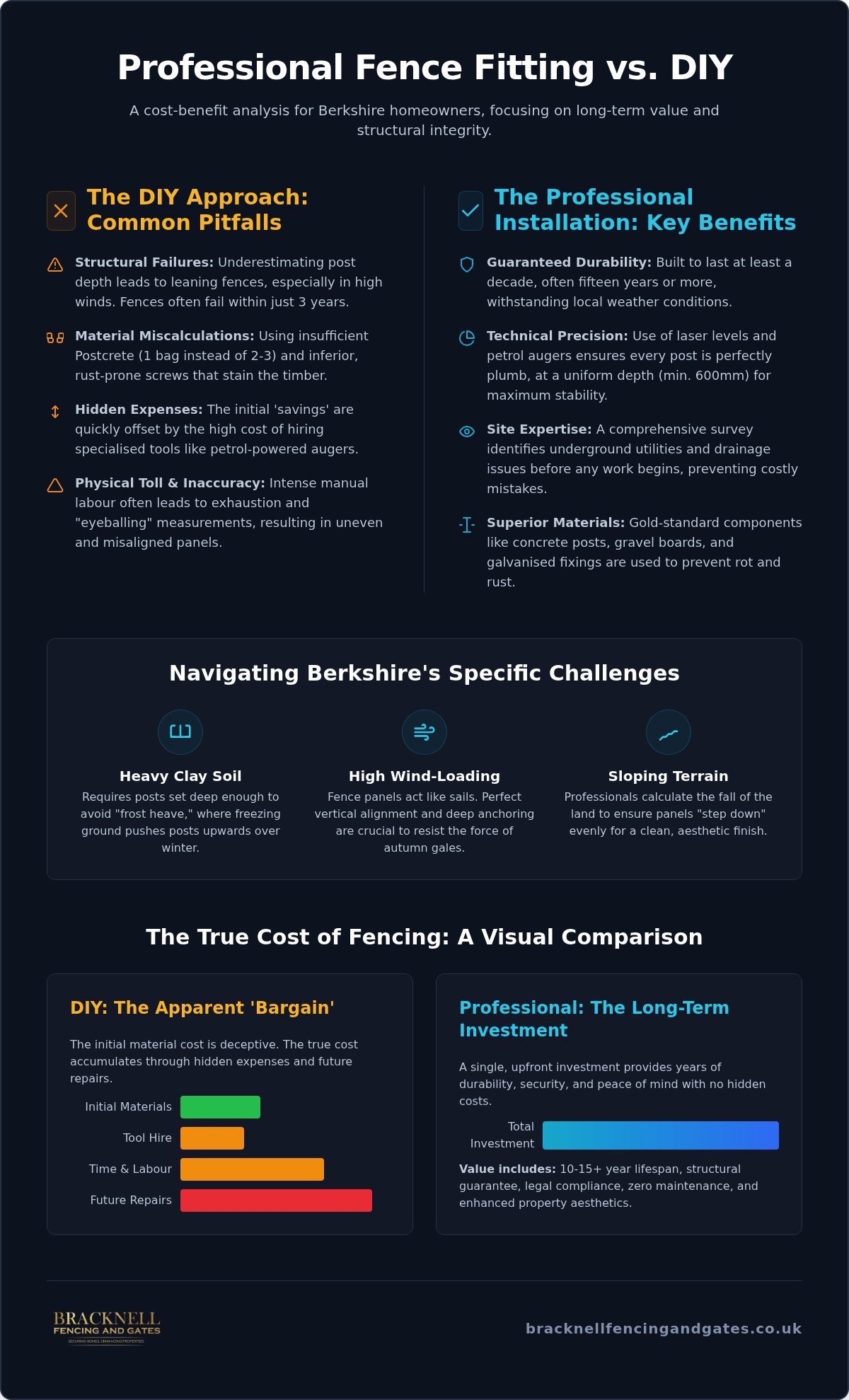
The True Cost of Fencing: DIY Expenses vs. Long-Term Value
When calculating the cost of a new boundary, most homeowners start with a basic shopping list: panels, posts, and bags of Postcrete. It’s easy to overlook the hidden expenses that quickly erode any perceived savings. Transporting ten 6ft closeboard panels requires a large vehicle, and disposing of an old, rotten fence often requires a skip or multiple trips to the recycling centre. These logistical hurdles add significant time and money to a project before the first hole is even dug.
Then there is the matter of equipment. To achieve the same results as professional fence fitting berkshire, you’ll likely need to hire a petrol auger or a cement mixer. Daily hire rates for professional-grade tools are substantial. When you add the cost of high-spec fixings and the inevitable “failure tax”-the price of replacing a poorly installed fence after a single winter storm-the professional option often proves to be the more economical choice over a ten-year period.
DIY vs. Professional Cost Comparison
The following table outlines the practical differences between a self-build project and a specialist installation. While DIY has a lower entry price, the long-term value sits firmly with professional services.
| Factor | DIY Approach | Professional Fitting |
|---|---|---|
| Initial Outlay | Lower (Materials only) | Higher (Materials + Labour) |
| Time Investment | High (Multiple weekends) | Low (Typically 1-2 days) |
| Expected Lifespan | 3-7 years | 10-15+ years |
| Workmanship Guarantee | None | Included as standard |
Quality Materials: Why Trade-Grade Timber Matters
There is a vast difference between the “big-box” retail panels found in local DIY stores and the trade-grade timber used by specialists. Retail panels are often thinner and use lower-grade staples that rust quickly. We focus on heavy-duty feather edge and closeboard systems that use UC4 pressure-treated timber. While UC3 treatment is common for general garden wood, UC4 is specifically designed for ground contact. It offers superior protection against rot and fungal decay in damp soil.
Choosing a specialist ensures your garden boundary isn’t just a temporary fix. A straight, sturdy fence significantly boosts the curb appeal of your property, which is a vital consideration in Berkshire’s competitive housing market. If you want to avoid the stress of a failed DIY project, request a fixed-price quote to ensure your project stays on budget and is built to last.
Securing Your Property: Why Professional Installation is a Sound Investment
A secure boundary is your home’s first line of defence. While a DIY fence might look the part from a distance, an intruder will quickly spot weak points like loose panels or shallow-set posts. Choosing professional fence fitting berkshire ensures your perimeter is structurally sound and acts as a genuine deterrent. A professionally installed closeboard fence, for example, is notoriously difficult to scale and offers no easy leverage points for forced entry. It provides a level of security that a quickly assembled weekend project simply cannot match.
Peace of mind also comes from maintenance-free living. When a fence is built using trade-grade materials and professional techniques, you won’t spend your bank holidays hammering loose slats or propping up leaning sections. The physical integrity of the work means the structure remains stable for at least a decade. It allows you to enjoy your garden rather than constantly working on it. This durability is what transforms a simple fence into a long-term property investment.
Enhancing Privacy and Security
Privacy is often the main reason for a new installation. We help you find the right balance between secluded garden living and staying within local planning regulations. A 2-metre high fence provides excellent privacy, but it only works if the entry points are equally secure. Integrating matching wooden side gates creates a seamless perimeter that keeps children and pets safe inside while keeping unwanted visitors out. For many homeowners across the county, adding sturdy driveway gates further enhances this security, providing a complete boundary solution that looks as good as it performs.
Choosing Your Berkshire Fencing Partner
Local knowledge is invaluable when planning your project. Understanding the nuances of Bracknell and the surrounding villages allows us to build fences that actually last. Opting for professional fence fitting berkshire means you are choosing a “safe pair of hands” for your property. We believe in transparent communication and fixed-price quotes. This approach eliminates the risk of “budget creep” and ensures you know exactly what the project entails before any work begins.
We take pride in being a dependable local specialist. Our focus is on providing a high-quality service that adds lasting value to your home. If you are ready to upgrade your garden boundary, the next step is a tailored assessment of your space. Book a professional site survey with Bracknell Fencing and Gates today to ensure your new fence is secure, legal, and built to the highest standards.
Secure Your Garden Boundary for the Long Term
Choosing between a weekend of manual labour and hiring a specialist involves more than comparing material costs. The long-term value of professional fence fitting berkshire is found in structural integrity and the total removal of future maintenance stress. By opting for expert installation, you protect your garden from the “failure tax” of DIY attempts while ensuring your boundary survives the unique wind loads and heavy clay soil found across the region.
Bracknell Fencing and Gates provides a dependable local service for homeowners in Bracknell, Wokingham, and Ascot. We specialise in heavy-duty closeboard and feather edge fencing, using trade-grade timber and concrete supports to guarantee a sturdy finish. Our commitment to fixed-price quotes means you won’t face budget creep or hidden extras once the work begins. It’s about doing the job right the first time.
Invest in a boundary that adds genuine value to your property and provides security for your family. Get a Fixed-Price Quote for Professional Fence Fitting in Berkshire and enjoy a perfectly level, storm-proof fence that lasts for years to come.
Frequently Asked Questions
How much does professional fence fitting cost in Berkshire?
The total cost depends on several variables, including the length of the boundary, your choice of materials, and the current condition of the ground. Whilst standard timber panels are a cost-effective option, a heavy-duty closeboard system with concrete posts requires a different level of investment. Factors such as the removal of old hedges or restricted site access will also influence the final figure. We always recommend a site visit to provide a fixed-price quote that avoids any budget creep.
Do I need planning permission for a new fence in Bracknell?
You generally don’t need planning permission for a rear garden fence that is up to 2 metres in height. This is considered permitted development for most residential properties. However, if your fence is adjacent to a highway or a public footpath used by vehicles, the legal height limit is typically restricted to 1 metre. If your home is a listed building or sits within a conservation area, it’s vital to check with the local council before starting any work.
Which is better for Berkshire gardens: concrete or wooden posts?
Concrete posts and gravel boards are the gold standard for durability in local gardens. Unlike timber, concrete doesn’t rot when in constant contact with damp earth, which is a major advantage in the heavy clay soil found around Bracknell. Using concrete provides a permanent, sturdy anchor for professional fence fitting berkshire. It ensures your boundary remains upright and secure for a decade or more without the need for structural repairs.
How long does it take for a professional team to install a garden fence?
A standard residential project typically takes a professional team between one and two days to complete. This timeframe includes the removal of your old fencing and the necessary ground preparation. Larger gardens or those with significant slopes and difficult access might require a little more time. Our methodical approach ensures the work is finished efficiently whilst maintaining the high standards of craftsmanship required for a long-lasting boundary.
Can you install a new fence if the ground is currently frozen or waterlogged?
We can install fencing in most weather conditions, including during the winter when the ground is frozen. Professional tools like petrol-powered augers allow us to penetrate hard earth that would be impossible to dig by hand. Whilst waterlogged clay makes the process more physically demanding, our expertise ensures that posts are still set to the correct depth and anchored securely. This prevents the fence from leaning or shifting once the ground dries out.
What is the most durable type of fencing for high-wind areas in Berkshire?
Closeboard fencing is the most resilient option for gardens exposed to high winds in the Thames Valley. Because it’s built on-site with individual feather edge boards and horizontal cant rails, it creates a rigid, heavy-duty structure. This design offers far better wind resistance than standard pre-made panels. When paired with concrete posts, it provides a secure boundary that is specifically engineered to withstand the strongest autumn gales.
Do I need to inform my neighbours before having a professional fit a new fence?
It isn’t a legal requirement to inform neighbours unless the fence is on a shared boundary, but it’s certainly good practice. You should check your property deeds and title plans to confirm boundary ownership before professional fence fitting berkshire begins. Discussing your plans early helps maintain good relations, especially if the installers need brief access to their side of the line to ensure a perfect finish.
What happens if my professional fence fitting encounters underground cables?
Specialists conduct a site survey to identify potential utility lines before any digging starts. If we encounter unexpected drainage pipes or cables, we adjust the post positions slightly to maintain the fence’s straight line without causing damage. This expert oversight is a significant benefit of hiring professionals; hitting a main power line or water pipe during a DIY project can be dangerous, disruptive, and incredibly expensive to repair.