
What if the roar of the M4 or the constant hum of the A329 didn’t have to be the permanent soundtrack to your Sunday afternoon? Most Berkshire homeowners accept traffic noise as an unavoidable trade-off for living in such a well-connected county, but it’s hard to relax when your outdoor space feels more like a hard shoulder than a sanctuary. If you’re looking for the most effective noise reduction fencing berkshire specialists can provide, you’ve likely wondered if a timber barrier can truly make a difference or if you’re just investing in a solution that won’t deliver the quiet you crave.
You can finally reclaim your garden’s peace with a professional solution tailored for our local landscape. We’ll show you how high-mass materials like heavy-duty closeboard fencing act as a natural sound barrier whilst enhancing your property’s value. This guide explains the vital role of professional installation in preventing sound leaks and explores the balance between cost and effectiveness. We’ll walk you through everything from local height regulations to choosing a design that looks like a high-quality garden feature, ensuring your project is in a safe pair of hands.
Key Takeaways
- Learn why high-mass materials like closeboard fencing are the most effective choice for blocking traffic noise in your garden.
- Understand the difference between reflective and absorptive barriers to choose the right noise reduction fencing berkshire solution for your property.
- Discover why professional installation, including the use of concrete gravel boards, is essential to prevent sound leaks that compromise noise control.
- See how even a small reduction in decibels can sound like a 50% drop in volume, significantly improving your outdoor peace and quiet.
- Find out how local experts assess your garden’s unique noise profile to create a peaceful sanctuary that doubles as a high-quality garden feature.
What is Noise Reduction Fencing and Why Do You Need It?
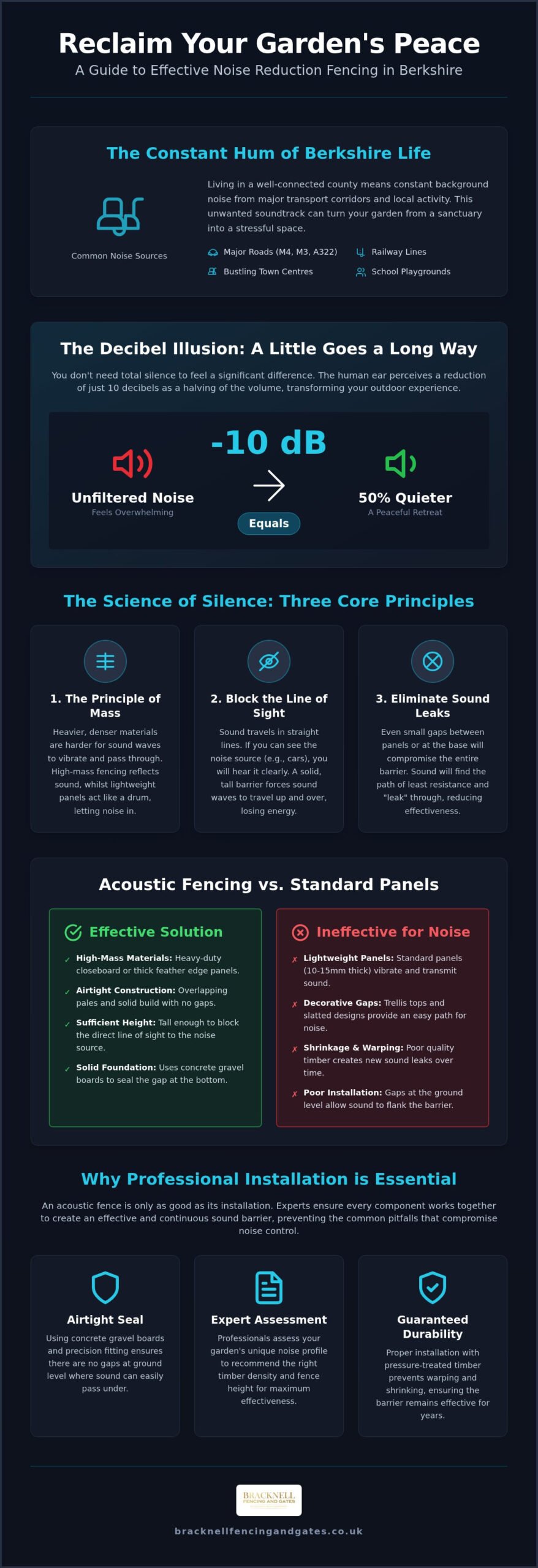
Noise reduction fencing isn’t just a standard garden border. It is a high-mass boundary specifically engineered to either reflect sound waves back toward the source or absorb them entirely. For homeowners seeking noise reduction fencing berkshire, the goal is often to create a “shadow zone” where sound levels are noticeably lower. Understanding The Science of Silence helps explain why density is the most important factor. Unlike standard fencing, these systems use thicker timber and airtight construction to block the path of environmental noise.
Many people find it surprising that a reduction of just 10 decibels (dB) can be perceived by the human ear as a 50% drop in volume. This “Decibel Gap” means you don’t need to eliminate every sound wave to transform your garden into a peaceful retreat. It is also vital to distinguish between “soundproofing” and “noise reduction.” True soundproofing happens in enclosed spaces like recording studios. In an outdoor setting, sound can still travel over the top or around the sides of a barrier. We focus on noise reduction, which significantly lowers the intensity of the sound reaching your ears.
Common Noise Pollutants in Berkshire
Living in the Thames Valley means being close to major transport corridors like the M4, M3, and the busy A322 through Bracknell. These roads produce a constant drone that standard feather edge panels struggle to block. Secondary noise sources like local railway lines, school playgrounds, and bustling town centres also contribute to the background hum. Reducing garden noise is essential for protecting property value in the Thames Valley, as a quiet outdoor space is a premium feature for any buyer.
How Fencing Acts as a Sound Buffer
The most critical rule of acoustic fencing is the “Line of Sight.” If you can see the cars or the train, you will certainly hear them. Sound waves travel like light; they move in straight lines until they hit an object. A poorly constructed fence with gaps between the slats allows sound to leak through effortlessly. A solid, high-mass barrier forces these waves to climb over the top, losing energy and volume in the process. When planning your layout, you might also consider low maintenance garden ideas Bracknell residents often pair with new fencing to create a complete, hassle-free sanctuary. By combining the right height with professional installation, you ensure that noise reduction fencing berkshire properties benefit from is as effective as possible.
The Science of Silence: How Fencing Materials Block Sound
Blocking sound is a game of physics. Sound waves are a form of physical energy that travels through the air, and to stop them, you need a barrier with significant mass. The Principle of Mass states that the heavier and denser a material is, the more difficult it is for sound to pass through it. Lightweight panels often vibrate when hit by sound waves, effectively acting like a drum skin and passing the noise directly into your garden. For effective noise reduction fencing berkshire gardens require, we always prioritise high-density timber over thin, decorative alternatives.
A common mistake is choosing a fence based solely on aesthetics. Decorative panels with trellis tops or loose slats might look attractive, but they provide almost zero acoustic benefit. Research into Effective Noise Reduction shows that even small openings can compromise the entire system. To truly quieten a space, the barrier must be solid, heavy, and continuous. If you’re planning a project and want to ensure you’re using the right density for your specific location, Bracknell Fencing and Gates can provide expert guidance on material selection.
Timber Density and Thickness
Standard garden fence pales are typically between 10mm and 15mm thick. While these are fine for marking a boundary, they’re far too thin to reflect the deep rumble of traffic from the M4 or A322. Heavy-duty closeboard fencing and thick feather edge systems offer the density needed to bounce sound waves back towards the source. We use pressure-treated timber to ensure the pales don’t warp or shrink over time, which would otherwise create new paths for sound to travel through.
Eliminating the ‘Sound Leaks’
The “flanking” problem is where sound finds the path of least resistance. It’s a sobering fact that a 1% gap in a fence can let in 10% of the noise. This makes the construction method just as important as the material itself. To prevent these leaks, we focus on airtight designs that leave no room for sound to bypass the timber.
- Overlapping Boards: Feather edge pales should have a generous overlap to ensure no light or sound passes through the joints.
- Tongue and Groove: This system is a favourite for acoustic performance because the pales interlock, creating a seamless timber wall.
- Gravel Boards: Using concrete gravel boards at the base prevents sound from leaking under the fence at ground level where the soil might be uneven.
By focusing on these structural details, you can turn a standard boundary into a high-performance acoustic shield. Professional installation ensures these pales are fitted tightly, maintaining the integrity of the barrier against both the wind and the constant hum of Berkshire’s roads.
Specialist Acoustic Barriers vs. Standard Fencing: A Comparison
When choosing noise reduction fencing berkshire homeowners usually face two main categories of specialist barriers: reflective and absorptive. Reflective fencing is the most common choice for residential properties. Its solid, dense surface is designed to bounce sound waves back towards the source, such as a busy road. Absorptive fencing takes this a step further by using internal mats to “soak up” the noise rather than just reflecting it. This is particularly effective in narrow gardens where sound might otherwise bounce between the house and the fence, creating an echo effect.
While these specialist systems are highly effective, they come with a significant price tag. For many, the most practical solution lies in a high-quality, heavy-duty timber alternative. A professional closeboard fencing installation provides the necessary mass and airtight construction to rival many basic acoustic panels at a more accessible price point. The goal is to create a solid wall of timber that sound waves cannot easily penetrate or vibrate through. According to WSDOT noise barrier guidelines, the effectiveness of any barrier is determined by its mass, its height, and its ability to remain gap-free.
When to Choose Specialist Acoustic Kits
In some scenarios, a standard timber fence might not be enough. If your property borders the M4 or a particularly loud section of the A322, a certified acoustic kit might be necessary to achieve a livable environment. These kits are often thicker and come with lab-tested decibel reduction ratings. However, you must consider planning permission. In West Berkshire, fences up to 2 metres are usually permitted development, but this drops to 1 metre if the fence is adjacent to a highway. Specialist barriers are often quite industrial in appearance, so there is a trade-off between pure performance and a traditional garden aesthetic.
The Power of Heavy-Duty Closeboard
A properly installed closeboard fence is often the best compromise for Berkshire residents. By using 125mm wide feather edge pales with a generous overlap, you create the density required for sound reflection. Adding concrete gravel boards at the base is essential to seal the gap between the timber and the ground. To complete the sound seal, ensure your side or driveway access is secured with a matching garden gate installation Bracknell. A heavy timber gate with a rebate frame acts as a final plug in your acoustic barrier, ensuring no noise leaks through the side of your home.
Professional Installation: The Key to Effective Noise Reduction
Buying high-quality timber is only half the battle. If you invest in noise reduction fencing berkshire specialists recommend, the final performance depends entirely on the quality of the fit. Sound waves act much like water; they will find and exploit the smallest opening in your boundary. A DIY attempt might look solid from a distance, but a 5mm gap under a panel or a loose joint between pales can let through a surprising amount of road noise. Professional installation ensures a truly airtight seal, transforming your garden from a noisy thoroughfare into a quiet retreat.
Managing the uneven terrain across Berkshire is another challenge. Whether your garden in Bracknell or Wokingham is perfectly flat or has a significant slope, the fence must follow the contours of the land without leaving triangular “sound leaks” at the base. We use precision levelling to ensure that every panel or closeboard section meets the ground or gravel board perfectly. If you want to ensure your boundary is fitted by a safe pair of hands, contact Bracknell Fencing and Gates for a professional installation quote.
The Importance of Concrete Gravel Boards
Gravel boards are the unsung heroes of acoustic fencing. By placing a solid concrete board at the base of your fence, you create a dense, low-level seal that blocks the heavy rumble of tyres on tarmac. This also keeps your timber pales away from damp soil, preventing rot and ensuring the structural mass of the fence remains intact for years. Some homeowners choose to pair their new boundary with garden sleeper installation Bracknell projects to create raised beds that add even more mass and sound-absorbing soil right at the garden edge.
Structural Integrity and Wind Loading
Acoustic-optimised fences are significantly heavier than standard panels. This increased mass means they catch more wind and put more stress on the support structure. We install posts at a greater depth than standard garden fences, often using reinforced concrete posts to provide a rigid backbone. This prevents the “drumming” effect, where a fence vibrates or rattles in high winds, which can actually generate its own noise. Choosing concrete posts over wooden ones in our damp Berkshire climate ensures your sound barrier won’t lean or fail after a few seasons of heavy rain. A sturdy, professionally fitted post is the only way to keep your garden quiet for decades, not just seasons.
Creating a Peaceful Berkshire Sanctuary with Bracknell Fencing and Gates
Choosing the right noise reduction fencing berkshire solution requires more than just picking a heavy material. It involves a detailed understanding of how sound moves through your specific garden. We take pride in being a “safe pair of hands” for these projects. Our team combines technical knowledge with a friendly, local approach to ensure your garden becomes the sanctuary you deserve. We don’t believe in one-size-fits-all barriers. Instead, we look at your boundary as a complete system. This includes selecting decorative fence panels that offer high density without sacrificing the visual appeal of your home. You don’t have to choose between a quiet garden and a beautiful one.
A quiet garden is often a low-maintenance one. Many homeowners choose to pair their new acoustic fencing with other garden improvements to create a cohesive outdoor space. Working with professional artificial grass installers Berkshire can help create a peaceful, soft-surfaced environment that requires minimal upkeep. While the fence blocks the traffic drone, the artificial lawn provides a lush, green space for relaxing or entertaining without the noise of a lawnmower. This holistic approach ensures every element of your garden contributes to a sense of calm and privacy.
A Bespoke Approach to Berkshire Gardens
Every property in Bracknell and the surrounding villages has unique boundary challenges. We focus on custom heights and heavy-duty materials to maximise sound deflection for your specific layout. Our local knowledge of Berkshire property types allows us to advise on the best placement for your barrier to achieve the maximum decibel drop. We also ensure your new fence integrates seamlessly with matching side or driveway gates. A heavy-duty gate with a tight seal is vital. Without it, the noise will simply find the easiest way into your garden through the side of your house, rendering the rest of the fence less effective.
Requesting Your Noise Assessment Quote
Our site visits are thorough. We don’t just measure the length of the run; we check the height of the noise source, such as the elevation of a nearby road, to determine the optimal fence height. We also assess the prevailing wind direction and your soil type to ensure the post foundations are rock solid. This methodical approach ensures your investment delivers results from day one. Our pricing is transparent, and our installation process is designed to be as low-friction as possible for the homeowner. Ready to reclaim your peace and quiet? Contact Bracknell Fencing and Gates for a noise reduction fencing quote today and start planning your quieter outdoor space.
Reclaim Your Garden’s Peace and Quiet
A peaceful outdoor space shouldn’t be a luxury for homeowners living near Berkshire’s busy road corridors. We’ve explored how high-mass materials and airtight construction are the only ways to truly block environmental noise. Whether you choose heavy-duty closeboard systems or specialist acoustic barriers, the success of the project relies on a gap-free, professional installation. As local Berkshire specialists, we understand how to manage uneven terrain and wind loading to ensure your fence remains a solid, durable barrier for years.
Our expertise in heavy-duty timber and high-mass installations makes us a safe pair of hands for your project. We take pride in helping our neighbours transform their gardens into private sanctuaries. If you’re ready to silence the traffic drone and enjoy your outdoor space again, request a free quote for noise reduction fencing in Bracknell. It’s the first step towards finding the most effective noise reduction fencing berkshire solution for your property. You can look forward to a summer spent relaxing in the quiet garden you deserve.
Frequently Asked Questions
How much noise can a garden fence actually block?
A well-installed acoustic barrier can reduce noise by approximately 5 to 10 decibels. Because the decibel scale is logarithmic, this small numerical change is perceived by the human ear as a 50% reduction in volume. To achieve these results with noise reduction fencing berkshire gardens require a solid, gap-free construction. The effectiveness depends on the mass of the timber and the proximity of the barrier to the noise source.
Do I need planning permission for a noise reduction fence in Berkshire?
Most homeowners in Bracknell don’t need planning permission for fences up to 2 metres in height. However, strict rules apply if the fence is adjacent to a highway or footpath, where the limit for permitted development is usually 1 metre. It’s best to check with Bracknell Forest Council or West Berkshire Council before starting, especially if your property is in a conservation area or near a listed building.
What is the best height for a fence to block traffic noise?
To block traffic noise effectively, the fence must break the line of sight between your ears and the noise source. A height of 2 metres is the standard for most residential gardens. For maximum performance, the barrier should be at least 50% taller than the source of the noise. If the road is elevated, you may need to discuss bespoke height solutions with a local specialist to ensure sound waves don’t travel over the top.
How long does a timber noise reduction fence last?
A professionally installed timber fence can last between 15 and 25 years. We use pressure-treated timber which resists rot and insect damage even in the damp Berkshire climate. Using concrete posts and gravel boards significantly extends this lifespan by keeping the timber away from ground moisture. Regular maintenance and ensuring the fence remains structurally sound will help it maintain its acoustic properties throughout its life.
Can I add noise-reducing materials to my existing fence?
You can add acoustic membranes to an existing fence, but it’s rarely as effective as a purpose-built system. These materials add significant weight that standard garden fence posts often can’t support. If the original fence has any gaps or loose panels, the sound will simply leak through regardless of the added material. We usually recommend a full replacement with heavy-duty closeboard fencing to ensure a complete sound seal.
Is closeboard fencing better for noise than feather edge?
Heavy-duty closeboard fencing is generally superior to standard feather edge panels for noise control. While both use vertical pales, closeboard is constructed on-site with thicker timber and a more substantial frame. This creates a denser, higher-mass barrier that is less likely to vibrate. When fitted with concrete gravel boards and a generous overlap, closeboard provides the airtight seal necessary for effective noise reduction fencing berkshire residents need for quieter gardens.
What is the difference between reflective and absorptive acoustic fencing?
Reflective fencing is designed with a hard, flat surface to bounce sound waves back towards the source, making it ideal for blocking road traffic. Absorptive fencing features an internal mat or mineral wool layer that traps and dissipates sound energy. This prevents sound from bouncing around narrow gardens or between buildings. Reflective barriers are the most common choice for Berkshire homes due to their durability and traditional timber appearance.
How much does professional noise reduction fencing cost in Bracknell?
The total investment for noise reduction fencing in Bracknell depends on several factors, including the mass of the materials and the complexity of the ground conditions. Specialist acoustic kits typically cost more than standard timber due to their certified decibel ratings. Factors such as the required height, the total length of the run, and the choice between wooden or concrete posts will influence the final quote for a professional installation.