
A survey by Higgs LLP estimated that 6.2 million Britons have been involved in a boundary dispute with a neighbour. It’s a staggering figure that highlights just how much stress a simple garden border can cause. Most of these disagreements start with one simple, nagging question: which side of the fence is my responsibility uk?
We understand the frustration. There’s often a genuine fear of paying for a costly replacement that isn’t yours, or the anxiety that a leaning panel might lead to a falling out with the people next door. It’s easy to get lost in conflicting urban myths about which way a fence should face or who owns which side. You want a clear answer so you can get on with your property improvements without the drama.
This guide will give you the legal reality of fence ownership. You’ll learn exactly how to identify your boundaries so you can make a clear plan for repairs or replacements. We’ll look at how to read your title deeds, the truth about the “left-hand rule,” and how to maintain a good relationship with your neighbours while securing your garden for the long term.
Key Takeaways
- Learn why the “left-hand side” rule is a persistent myth and how to identify your actual legal obligations through property records.
- Discover how to interpret T-marks and H-marks on your title deeds to confirm exactly which side of the fence is my responsibility uk.
- Understand how physical features, such as the position of posts and rails, can offer practical clues about boundary ownership.
- Find out how to manage shared “party boundaries” and the best way to discuss repair costs with your neighbours politely.
- See why professional installation is vital for ensuring your boundary remains secure and durable against the local Berkshire weather.
Debunking the ‘Left-Hand Side’ Myth: How UK Boundary Law Actually Works
The idea that you always own the fence on the left-hand side of your garden is perhaps the most common misconception in British property. It’s a myth that has caused countless arguments over the garden hedge for decades. In reality, there is no nationwide legislation that dictates ownership based on direction. The confusion often starts because some housing developers chose a consistent pattern when building estates to make maintenance easier for the original buyers. However, this was a choice made by a builder, not a requirement of UK Boundary Law. Every property is a unique legal entity with its own specific history.
Why the ‘Left-Side Rule’ is Fiction
Property ownership is determined by the specific legal history of your land, not which way your house faces. Whilst one street in Bracknell might follow a left-side convention, the very next road could be entirely different. Relying on what a previous owner told you or a “gentleman’s agreement” is risky. These verbal promises aren’t legally binding and won’t help you if a neighbour decides to challenge who should pay for a new fence. Relying on myths is dangerous for several reasons:
- It can lead to you paying for a fence you don’t legally own.
- It might cause you to inadvertently trespass on a neighbour’s land during installation.
- It creates confusion and delays when it’s time to sell your property.
- It often escalates minor repairs into full-blown legal disputes that could have been avoided.
The Reality of Boundary Responsibility
When you’re trying to figure out which side of the fence is my responsibility uk, the first place to look is your property’s title deeds. If these records are silent, the boundary might be a “party boundary.” This means you and your neighbour share joint responsibility for its upkeep. It’s a common setup, yet it’s also a frequent source of tension. Without a clear agreement, you can’t legally force a neighbour to pay for repairs, nor can they force you.
This lack of a universal law is why so many homeowners find themselves in a stalemate when a storm damages a shared panel. Instead of guessing, you should check the Conveyance Deeds. These are the original documents created when the land was first partitioned and sold. They often contain much more detail than the simplified plans held by the Land Registry and are the only way to be certain of your position. Assumptions lead to expensive mistakes, so checking your records before you start digging post holes is the only way to ensure you aren’t paying for a fence that belongs to someone else.
Identifying Ownership: T-Marks, Title Deeds, and the Land Registry
To settle the question of which side of the fence is my responsibility uk, you must look at the legal paperwork. Your property’s title deeds and title plan are the most reliable sources of information. You can download these documents from the HM Land Registry website for a £3 fee. This small investment provides a clear map of your property boundaries as they were recorded when the land was first developed.
It is helpful to remember that most title plans only show “general boundaries.” According to HM Land Registry guidance, the red line on a plan doesn’t always indicate the exact physical position of a fence. Instead, you should look for specific symbols that clarify maintenance duties.
Decoding the T-Mark System
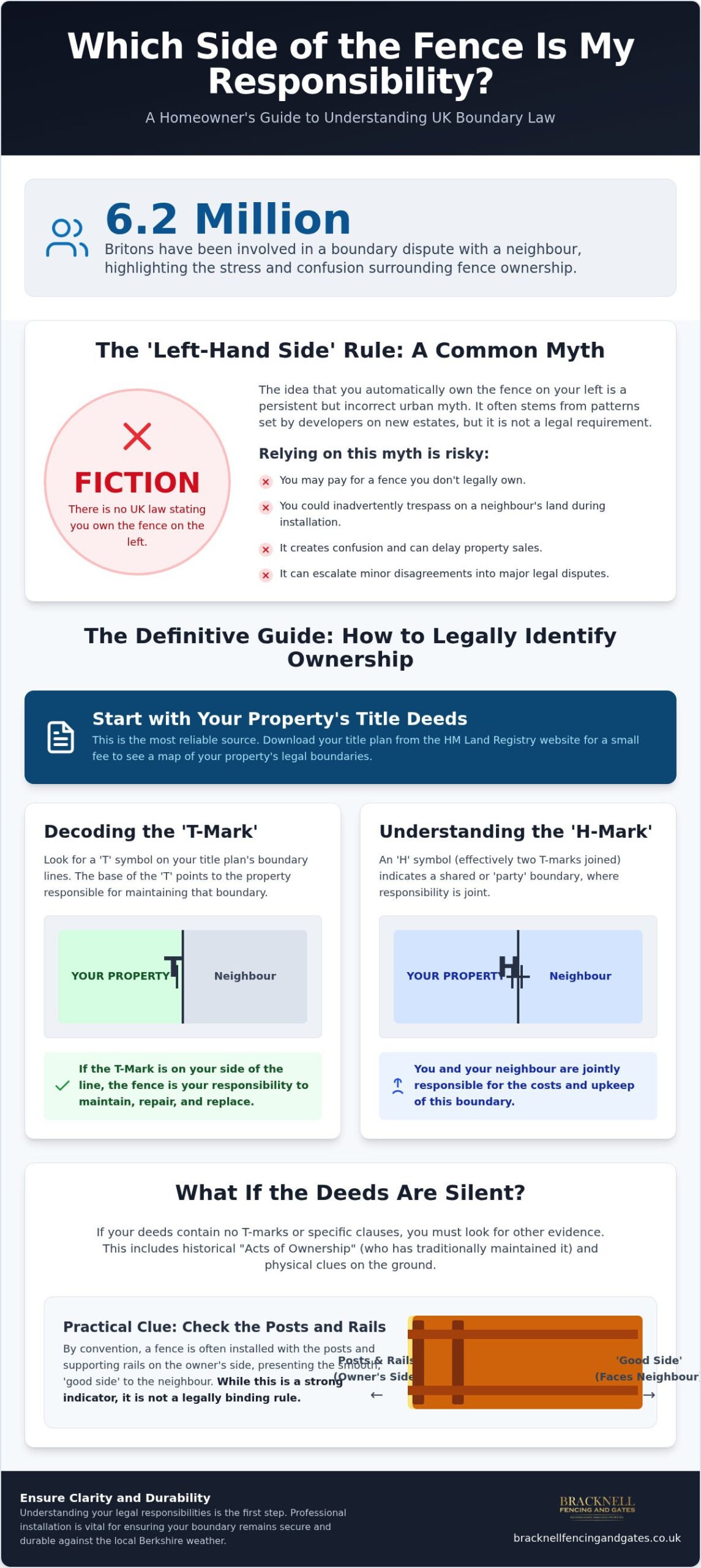
The most common indicator on a title plan is the “T-mark.” This is a capital letter T drawn on one side of a boundary line. The stem of the T points directly into the land of the person responsible for that boundary. If the T-mark is on your side of the line, the fence is yours to maintain, repair, and replace.
Occasionally, you might see an “H-mark.” This looks like two T-marks joined together at the crossbar, spanning both sides of the boundary line. This symbol indicates a shared or “party” boundary. In these cases, you and your neighbour are jointly responsible for the costs and upkeep of the structure. Knowing this early helps you avoid conflict and allows you to plan shared fence repairs with confidence.
When Deeds Provide No Answer
Sometimes, title deeds are silent. If no T-marks or written covenants exist, you have to look at “Acts of Ownership.” This involves looking at the history of the property to see who has traditionally looked after the boundary. If a previous owner of your house always painted the fence or replaced the panels, this can be used as evidence of responsibility. Similarly, if a hedge was planted on one side of a ditch, the person who owns the hedge is usually responsible for the boundary.
For more complex or irregularly shaped plots, historical maintenance might not be enough to confirm which side of the fence is my responsibility uk. In these instances, consulting a professional land surveyor is the safest route. They can use the original conveyance deeds and physical measurements to determine the precise boundary line. Settling these details now ensures that when you invest in high-quality installations, your boundary remains secure and undisputed for years to come. Once ownership is clear, you can focus on choosing durable materials that will stand up to the local climate.
Visual Clues: Does the ‘Good Side’ Always Face the Neighbour?
When property deeds are unclear, many homeowners look at the fence itself for clues. A common convention in the UK is that the “good” side of the fence, the smooth face without visible posts or rails, should face your neighbour. This isn’t just about being polite. Historically, builders installed the structural elements on the owner’s side to ensure the fence didn’t encroach on the neighbouring land. However, while this is a helpful rule of thumb, it isn’t a legal requirement. You shouldn’t rely on the position of the rails alone to decide which side of the fence is my responsibility uk.
The Post and Rail Convention
The tradition of putting the neat side facing out started for practical reasons. By keeping the posts and horizontal rails on your own land, you ensure that you have full access to the structure for future maintenance without needing to step into your neighbour’s garden. It also makes it easier to replace panels or secure loose timber from your own side. Whilst this layout is common across Berkshire, it’s vital to remember that a previous owner might have installed the fence “backwards” or simply chosen a different style. Visual evidence is always secondary to the legal facts found in UK Government Property Boundaries records.
Modern Fencing and Double-Sided Panels
Modern materials have made the “good side” rule much harder to follow. For instance, high-quality closeboard fencing is often constructed on-site with a sturdy framework of posts and rails that are visible from one side. However, many homeowners now opt for decorative panels or “hit and miss” styles that look identical from both sides. This trend towards symmetrical design is even more apparent with composite fencing, which offers a clean, finished appearance for both you and your neighbour.
The use of concrete posts and gravel boards also changes the visual cues. These components are standard for durable installations in our area because they prevent timber rot and withstand heavy winds. Because concrete posts are often grooved on both sides to hold the panels in place, they look the same from every angle. This makes it impossible to determine ownership just by looking at the post position. If you’re unsure about which side of the fence is my responsibility uk, don’t make assumptions based on the style. Professional installation ensures your boundary is respected, but only your deeds can provide the final, legal word on who owns the structure.
Shared Boundaries and Neighbour Disputes: What if the Deed is Silent?
When your title deeds provide no clear answer, you may find yourself dealing with a shared boundary. In legal terms, this is often referred to as a “party boundary.” This means neither neighbour owns the fence exclusively. Instead, you both share joint responsibility for its maintenance and replacement. Whilst this sounds simple, it is a frequent trigger for the 6.2 million boundary disputes estimated by Higgs LLP in 2024. If you are struggling to determine which side of the fence is my responsibility uk, and the paperwork is silent, the best approach is cooperation rather than confrontation.
It’s a common mistake to assume you can simply fix a fence that looks “bad” from your side. If the fence belongs to your neighbour, or is shared, you cannot legally paint it, attach hanging baskets, or replace it without their explicit permission. Doing so can be classed as criminal damage or trespass. If a storm has damaged a shared panel, talk to your neighbour before calling a contractor. A polite conversation over the garden gate is often enough to prevent a minor repair from becoming a long term legal headache.
Managing Shared Responsibility
Splitting costs 50/50 is the most common way to handle a shared boundary. To avoid future confusion, always document your agreement in writing. A simple dated note signed by both parties, detailing the materials used and the cost split, can prevent arguments if one of you decides to move house. If a neighbour refuses to contribute to a shared fence, you cannot legally force them to pay. In this situation, many homeowners choose to erect a new fence entirely within their own boundary line. This gives you total control over the style and maintenance, though it does mean sacrificing a few inches of garden space.
Avoiding Legal Conflict
Maintaining peace often requires a bit of compromise. For example, if you have overhanging branches from a neighbour’s tree, you have a right to trim them back to the boundary line, but you must offer the clippings back to them. Similarly, you shouldn’t lean heavy items against a neighbour’s fence, as the pressure can cause the panels to bow or the posts to fail. If a dispute does escalate, mediation is a much cheaper and faster option than seeking legal advice or going to court.
For those who want a permanent record of their agreement, you can lodge a “boundary agreement” with the Land Registry. This document officially records the agreed line and responsibility, making it easier for future owners. If you’ve reached an agreement with your neighbour and are ready to install a durable, long lasting border, you can contact our team for a professional installation that respects your property limits and provides total peace of mind.
Maintaining and Replacing Your Fence in Bracknell
Once you have identified which side of the fence is my responsibility uk, the next step is assessing the condition of the structure. In Berkshire, our gardens are often exposed to heavy winds and varying soil conditions that can take a toll on timber. Deciding whether to patch up an existing border or invest in a full replacement depends on the structural integrity of the posts. If the main supports are rotting at the ground level, a simple repair may only be a temporary fix. Upgrading to professional fence repair services in Bracknell can help you determine the most cost effective path forward.
Choosing the right materials is essential for long term peace of mind. Whilst traditional timber remains a favourite for its natural look, many homeowners are now moving towards composite options or closeboard panels for better durability. High quality materials, when combined with professional fitting, ensure that your boundary remains exactly where it should be, preventing the “boundary creep” that often leads to future neighbour disputes.
The Bracknell Factor: Wind and Soil
Sturdy boundary fencing is essential for many residential areas in Berkshire, particularly in more exposed estates. Our local soil can hold moisture, which often leads to premature rot in wooden posts that haven’t been properly treated or installed. To combat this, we frequently recommend the use of concrete posts and gravel boards. These components provide several practical benefits:
- They do not rot or decay when in contact with damp ground.
- They provide a heavy, stable anchor that prevents the fence from leaning during winter storms.
- They keep the wooden panels off the wet soil, significantly extending the life of the timber.
When planning a replacement, you must also consider local planning rules. As of 2026, permitted development rights generally allow for fences up to 2 metres high in rear gardens. However, if your fence is next to a highway used by vehicles, the limit is typically 1 metre. Under the Levelling Up and Regeneration Act 2023, local authorities now have up to 10 years to take enforcement action against planning breaches, so getting the height right from day one is vital. Our detailed guide to planning permission for fence Bracknell projects covers exactly when you need a permit and how to avoid costly enforcement notices.
Planning Your Replacement
Professional installation is a “safe pair of hands” for any boundary work. It ensures that the new structure sits precisely on your legal line, avoiding accidental encroachment on your neighbour’s land. At Bracknell Fencing and Gates, we take pride in accurate alignment and methodical construction. We understand that a fence is more than just a barrier; it is a permanent improvement to your home that should provide security and aesthetic value for years.
If you are still unsure about which side of the fence is my responsibility uk, or if you’ve confirmed ownership and are ready to upgrade, the best next step is a site survey. This allows us to assess your specific ground conditions and boundary layout. We can then provide a clear, no-nonsense plan for a durable installation that respects your property limits and maintains a positive relationship with those living next door.
Securing Your Boundary with Confidence
Determining ownership doesn’t have to be a source of stress. By checking your title deeds and understanding T-marks, you’ve moved past the common myths that often lead to neighbour disputes. You now know that visual clues like the “good side” are helpful hints but not legal proof. Whether your boundary is shared or solely yours, the best way to protect your garden is through clear communication and the use of durable materials.
If you’re still asking which side of the fence is my responsibility uk or need help assessing a damaged border, our team is ready to assist. We have expert local knowledge of Bracknell boundaries and specialise in durable, wind-resistant fencing designed for the Berkshire climate. From high-quality closeboard to sturdy feather edge options, we provide the craftsmanship needed to keep your garden secure and your property lines clear.
Get a professional quote for your fence repair or installation in Bracknell to ensure your new boundary is installed with precision and care. You’ll gain peace of mind knowing your property is in a safe pair of hands. We look forward to helping you transform your garden with a fence that’s built to last.
Frequently Asked Questions
Is it always the left-hand side fence that I own in the UK?
No, the idea that you always own the left-hand fence is an urban myth with no legal basis. Ownership depends entirely on the history of your specific property and the covenants in your deeds. Whilst some housing developers choose a consistent pattern for ease of maintenance, this isn’t a universal rule. To be sure about which side of the fence is my responsibility uk, you must check your official property records rather than relying on local assumptions.
How do I find out for certain which fence is mine?
You can confirm ownership by downloading your title register and plan from the HM Land Registry website. The fee is £3 per document as of 2026. These plans often show T-marks or contain written details of your boundary duties. If your deeds are silent, you should look for “Acts of Ownership,” such as who has traditionally maintained the panels. For complex plots, a professional land surveyor can help establish the exact legal line.
What does a T-mark on a property plan mean?
A T-mark is a symbol used on property plans to indicate boundary ownership. The stem of the “T” points into the land of the person responsible for that specific boundary. If the T-mark is on your side of the line, the maintenance and repair of that fence are your legal duty. Conversely, an H-mark, which looks like two T-marks joined together, indicates a shared or party boundary where both neighbours have joint responsibility for upkeep.
Can I force my neighbour to fix their broken fence?
Generally, you cannot legally force a neighbour to repair a broken fence that they own. UK law doesn’t actually require most homeowners to have a boundary fence at all. If a neighbour’s fence is falling down and they won’t act, your best recourse is to install your own separate fence entirely within your own property line. This gives you full control over the maintenance and ensures your garden remains secure and private.
Can I paint the side of the fence that faces my garden?
You can only paint the fence if you are the legal owner. If the fence belongs to your neighbour, painting your side without their explicit permission could be considered criminal damage or trespass. Even if the panels look weathered, you must seek consent before applying any stain or colour. To avoid disputes, it’s always best to have a polite conversation with your neighbour first or check your deeds to confirm which side of the fence is my responsibility uk.
Who pays for a fence that sits exactly on the boundary line?
If a fence sits exactly on the boundary line and is marked as a shared “party boundary” in the deeds, both neighbours are typically expected to split the costs 50/50. It is essential to agree on the style and price of the replacement before any work begins. If one party refuses to pay, you cannot force a contribution. In these cases, you might choose to pay the full amount yourself or install a separate fence on your own land.
Do I need my neighbour’s permission to replace my own fence?
No, you do not need legal permission to replace a fence that you own, provided it stays within your boundary and meets planning regulations. However, it is always polite to inform your neighbour before work starts. You must also ensure that your contractors do not trespass onto the neighbouring land during the installation. If the fence is shared, you must reach a mutual agreement with your neighbour before making any changes to the structure.
What is the maximum height a garden fence can be in the UK?
Under general permitted development rules, a fence in a rear garden can be up to 2 metres high. If the boundary is next to a highway or footpath used by vehicles, the limit is usually 1 metre. To go higher, you must obtain planning permission for fence Bracknell projects from your local authority. Since April 2026, the application fee for this in England is £272. Always check for local conservation area restrictions before starting your project.