
Could a simple garden upgrade lead to a legal headache and a forced demolition? It’s a common worry for many residents, especially when the rules regarding planning permission for fence Bracknell projects seem to change every few years. You want your home to be secure and private, but the last thing you need is a dispute with the council or a “notice to remove” landing on your doorstep. We understand that local regulations often feel like a maze of jargon designed to catch you out.
Our 2026 guide is here to give you the clarity you need to build with confidence. We’ll show you exactly when you can proceed without a permit and when the £528 council application fee becomes necessary. From mastering the 2-metre rule to understanding why your distance from the road matters, we have broken everything down into simple steps. By the end of this article, you’ll know precisely how to keep your project legal, durable, and council-approved.
Key Takeaways
- Understand the “2-metre rule” to determine if your rear garden fence qualifies for permitted development without a formal application.
- Learn why fences adjacent to highways or public footpaths are restricted to 1 metre in height to avoid potential council enforcement.
- Discover exactly how to navigate the process of obtaining planning permission for fence Bracknell, including the 2026 application fee of £528.
- Identify if your property is within a Bracknell Conservation Area or is a listed building, as these designations often remove standard building rights.
- See how professional installation ensures your new boundary is measured accurately to meet legal limits and prevent future boundary disputes.
Understanding Permitted Development for Fencing in Bracknell
“Permitted Development” is a term you’ll hear often when discussing planning permission for fence Bracknell projects. In simple terms, it’s a set of rights that allows homeowners to make minor improvements without needing a formal planning application. These rights are granted by the government rather than the local council; this means you don’t always have to wait for a green light from Bracknell Forest Council before starting work. It provides a level of freedom for homeowners to secure their boundaries efficiently.
The General Permitted Development Order Explained
The UK planning permission system is governed by the General Permitted Development Order (GPDO). This national legislation provides a baseline for what is allowed across Berkshire. Most residential houses in Bracknell benefit from these automatic rights, which cover the erection, construction, or alteration of a gate, fence, or wall. However, it’s vital to remember that these rights don’t apply to every home. If you live in a flat or a maisonette near the town centre, your property likely doesn’t have permitted development rights. In these cases, you’ll almost always need to submit an application for any new boundary treatment.
The age and history of your home also play a significant role. When new housing estates are built in areas like Jennett’s Park or Warfield, the council sometimes removes these rights through “restrictive covenants” or specific planning conditions. This ensures the open-plan feel of a new development is maintained. Additionally, certain streets may be subject to “Article 4 Directions.” These are specific local rules that strip away permitted development rights to protect the character of a neighbourhood. Checking your property deeds or the council’s website for these restrictions is a necessary first step for any planning permission for fence Bracknell enquiry.
Checklist: Does Your Project Qualify?
Before you order your closeboard panels or feather edge boards, run through this quick checklist to see if you can proceed without a formal application:
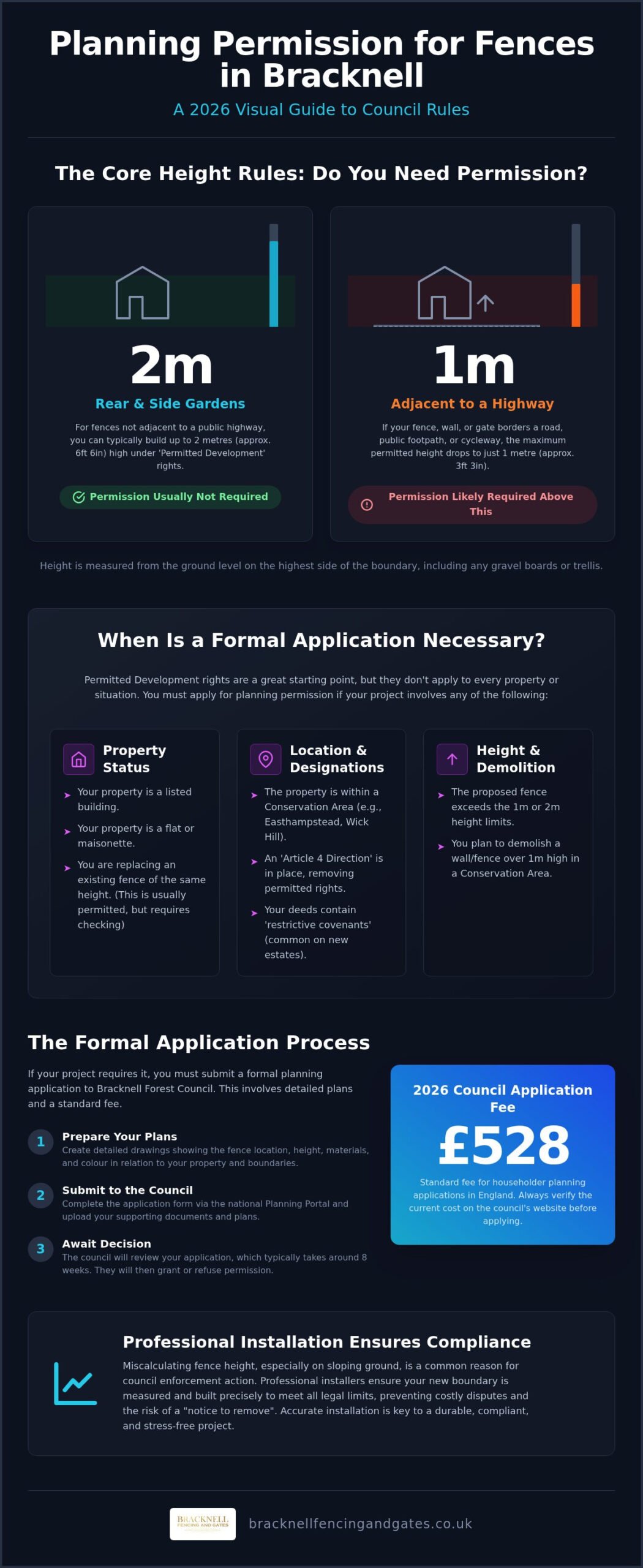
- Is the height compliant? Generally, you can build up to 2 metres; however, this drops to 1 metre if the fence is next to a highway used by vehicles.
- Are you replacing like-for-like? If you’re simply replacing an old fence with one of the same height, you usually won’t need new permission. If your panels have been damaged by bad weather, our guide to storm damage fence repair in Bracknell can help you understand when a simple panel swap is sufficient and when deeper structural work is needed.
- Is your home a listed building? Properties with listed status almost always require consent, regardless of the fence height.
- Are you in a conservation area? In spots like Easthampstead or Wick Hill, stricter rules apply to the demolition of existing walls or fences over a certain height.
If you tick all the right boxes, you can likely move forward with your installation. If you’re unsure, seeking professional advice ensures your project stays on the right side of the law and avoids the risk of enforcement action.
The 1-Metre and 2-Metre Rules: Height Limits in Berkshire
Transitioning from the general concept of permitted development, the specific height of your boundary is the most common trigger for a formal application. In Bracknell, these limits are strictly enforced to maintain the character of our local streets. For most rear and side garden boundaries, you can install a fence up to 2 metres in height without needing planning permission for fence Bracknell. These national fence height limits are the standard across the UK, but local context determines how they apply to your specific plot.
Accuracy in measurement is where many projects fail. The council considers the total height from the ground level on the highest side of the boundary. This means you must include the height of any concrete gravel boards and any trellis toppers in your final calculation. If you’re on sloping ground, the measurement is taken from the highest point adjacent to the fence. If you’re unsure about the topography of your boundary, you can organise a professional site survey with the team at Bracknell Fencing and Gates to ensure your project stays within the legal limits.
Fencing Adjacent to a Highway
The rules become significantly more restrictive when your fence borders a highway. Bracknell Forest Council defines a highway broadly, encompassing not just main roads but also public footpaths, cycle ways, and bridleways. If your fence is adjacent to any of these, the permitted height drops to just 1 metre. This restriction is primarily about safety; it ensures that visibility splays for driveways and junctions are not obstructed. Don’t assume that a front garden fence can match the height of your rear boundary without seeking planning permission for fence Bracknell first.
Rear Garden Privacy and the 2-Metre Limit
Most homeowners find the 2-metre limit sufficient for creating a private, secure space. This is the reason why 6ft (1.83m) panels are our most popular choice for closeboard and feather edge installations. It allows for a sturdy gravel board at the base whilst keeping the total height comfortably under the legal threshold. Some residents try to add trellis to the top of a 2-metre fence, believing it doesn’t count towards the limit. However, the council views any fixed structure as part of the total height. If the combined structure exceeds 2 metres, you risk facing an enforcement notice and being forced to lower the fence at your own expense.
Conservation Areas and Listed Buildings: Special Considerations
While the height limits discussed earlier provide a solid baseline, the specific designation of your land can change everything. If you live in a conservation area or own a listed property, the usual rules regarding planning permission for fence Bracknell projects are often overridden by the need to preserve local heritage. In these sensitive locations, the council takes a much closer look at materials, styles, and even the removal of old boundaries. It is not just about how high the fence stands; it is about how the structure respects the historic character of the neighbourhood.
Article 4 Directions in Bracknell
An Article 4 Direction is a legal tool used by the council to remove specific permitted development rights from a particular street or area. In parts of Bracknell such as Wick Hill or the older residential pockets of Easthampstead, these directions might prevent you from erecting any new boundary without formal consent, even if it is under the 2-metre limit. This is usually done to protect the visual harmony of a historic street or to maintain a specific open-plan layout. You can verify your property’s status by checking the interactive maps on the Bracknell Forest Council planning rules portal. Building a fence where an Article 4 Direction is in place without prior approval can lead to a “notice to remove,” so checking your status is a vital step before you start digging post holes.
Listed Building Consent for Fencing
For owners of listed buildings, the fence is rarely seen as a simple garden boundary. It is legally considered part of the “curtilage” of the historic structure. This means any change to the boundary, including replacing an existing fence, requires Listed Building Consent. The primary concern for the council is the impact on the building’s character and setting. Modern materials like composite fencing or certain high-gloss decorative panels might be rejected in favour of traditional closeboard or feather edge timber. Even the specific colour of the stain or paint you choose could be subject to approval to ensure it matches the local Berkshire aesthetic.
When dealing with a listed property or a sensitive conservation area, keep these additional rules in mind:
- Demolition restrictions: In a conservation area, you often need permission to take down a fence or wall that is over 1 metre high if it is next to a highway.
- Material sensitivity: The council may require you to use traditional construction methods, such as specific timber grades, to match neighbouring properties.
- Consultation: We always recommend a quick conversation with the local Conservation Officer before you finalise your plans.
Taking these extra steps ensures your project respects the local history whilst providing the security you need. It is about being a “safe pair of hands” for the town’s heritage. If you are unsure whether your home falls into these categories, we can help you navigate the planning permission for fence Bracknell requirements to ensure your new installation is fully compliant and legally sound.
How to Apply for Planning Permission in Bracknell Forest
If your project doesn’t fall under permitted development, you’ll need to make a formal application. This isn’t as daunting as it sounds. Most residents use the national Planning Portal to submit their plans directly to Bracknell Forest Council. It’s a structured process that ensures the council has all the information needed to judge your project against local standards. Taking the time to get your paperwork right at the start prevents delays later on.
Preparing Your Application
To get your planning permission for fence Bracknell application right the first time, you must provide clear documentation. The council requires a site location plan and a block plan. A block plan shows the exact position of the fence in relation to your house and the street, usually at a scale of 1:200 or 1:500. You should also include elevation drawings. These show the height and design of the fence from the side, which is vital if you’re installing something like decorative fence panels. We recommend including photos of the current boundary. This helps the planning officer understand the context of your request. For properties in sensitive areas, a brief Design and Access Statement might be necessary to explain why your chosen style is appropriate.
Fees and Decision Times
In 2026, the planning application fee for a fence at a single dwelling is £528. Once you’ve submitted your documents and paid the fee, the council usually takes about 8 weeks to reach a decision. During this time, they’ll notify your immediate neighbours. They have 21 days to submit any comments or objections. If an objection is raised, the council will weigh it against local planning planning policies. They don’t just reject applications because a neighbour dislikes the look of a fence. If you want legal certainty without building a non-compliant structure, you can apply for a Lawful Development Certificate. This provides formal proof that your fence didn’t need permission in the first place.
Getting the measurements and drawings exactly right is the best way to avoid a refusal. If you’re worried about the technical side of the paperwork, we can help you plan your installation to ensure it meets all the council’s requirements from day one.
Professional Installation: Ensuring Your Fence is Compliant
Knowing the rules is the first step, but physical execution is where many homeowners run into trouble. Professional installation isn’t just about the manual labour; it’s about precision. A fence that’s slightly too high or drifts over a boundary line can quickly become a legal burden. By hiring a local specialist, you’re investing in a “safe pair of hands” that understands how to translate council guidelines into a finished product that stands the test of time. We take the guesswork out of the process, ensuring your project meets all the criteria for planning permission for fence Bracknell projects from the very first post.
Accuracy and Boundary Responsibility
Many council complaints arise from “DIY height” errors. It’s easy to miscalculate when working on uneven ground or when adding decorative toppers. We use professional levelling tools to ensure that every panel stays within the legal limits, regardless of the terrain. We also help you identify which side of the fence is your responsibility before any ground is broken. This prevents accidental encroachment on a neighbour’s land, which is a common trigger for planning permission for fence Bracknell disputes and local enforcement visits.
Gravel boards are essential for a compliant and level finish. They provide a stable base for your panels, ensuring the height is consistent across the entire length of the boundary. They also prevent the timber from touching the damp soil, which significantly increases the lifespan of your installation. Using concrete posts and gravel boards provides the structural integrity needed to prevent “boundary creep” over time. If you’re dealing with rotting wooden posts that are undermining your fence’s stability, our comprehensive guide to replacing wooden fence posts with concrete in Bracknell explains how upgrading to concrete posts can deliver a boundary that lasts over 20 years in our local clay soil conditions. This keeps your fence exactly where it’s supposed to be, protecting your property rights and your relationship with your neighbours. If a storm has already compromised your existing boundary, understanding the full scope of storm damage fence repair in Bracknell — including when hidden post rot requires a complete replacement — can save you from repeated failures.
Choosing the Right Style for Your Area
Every Bracknell neighbourhood has its own aesthetic, from the traditional feel of older residential streets to the modern lines of newer developments. Choosing a style that complements your surroundings makes it much more likely that your project will be accepted by the community. We specialise in professional closeboard fencing installation, which is the gold standard for durability and privacy in Berkshire. This style is robust, visually appealing, and fits perfectly within the local planning expectations.
Whether you need a simple repair or a full boundary replacement, our team provides expert advice on local standards. We ensure all installations meet height regulations to avoid council disputes, using high-quality feather edge and composite materials. Contact Bracknell Fencing and Gates today for a compliant, professional quote that gives you total peace of mind for your 2026 garden project.
Secure Your Boundary with Confidence in 2026
Building a new fence shouldn’t be a source of stress. By understanding the height limits for rear gardens and the stricter rules for boundaries near highways, you can avoid the common pitfalls of the planning permission for fence bracknell process. Whether your project is a simple repair or a full installation of closeboard panels, staying within the legal framework ensures your home remains a private and secure sanctuary without council interference.
As local specialists, we bring expert knowledge of Berkshire planning rules to every project. We handle the technical details, from precise boundary assessment to ensuring every post is set at the correct legal height. Our team is dedicated to providing high-quality closeboard and gate installations that look great and stay fully compliant. Don’t leave your property’s legal status to chance.
Request a free, compliant quote for your new fence today and let us handle the hard work. We look forward to helping you transform your garden with a boundary that’s built to last.
Frequently Asked Questions
Do I need planning permission for a 6ft fence in my back garden in Bracknell?
Generally, you don’t need permission for a 6ft fence in a rear garden. 6ft converts to roughly 1.83 metres, which stays safely under the 2-metre threshold for permitted development. However, this only applies if your property isn’t a listed building and your permitted development rights haven’t been removed. Always verify your specific property status before starting work to avoid any future disputes with the council planning department.
How high can a fence be without planning permission in the UK?
Under national rules, you can build up to 2 metres high without a formal application. This limit drops to just 1 metre if the structure is adjacent to a highway used by vehicles, which includes public footpaths and bridleways. If you want to exceed these heights, you must apply for planning permission for fence Bracknell projects. These rules ensure road safety and maintain the character of local neighbourhoods across Berkshire.
Can my neighbour put up a fence without my permission in Bracknell Forest?
Your neighbour can usually erect a fence on their own land without your consent, provided it meets the standard height regulations. They don’t need your permission to choose the style or colour, though it’s always better to discuss plans first to maintain good relations. If the fence crosses the boundary line or exceeds legal height limits, you can contact Bracknell Forest Council’s enforcement team to investigate the matter formally.
Is trellis included in the 2-metre fence height limit?
Yes, trellis is absolutely included in the total height calculation. The council measures from the ground level on the highest side to the very top of the structure. If you place a 30cm trellis on top of a 1.8-metre fence, the total height reaches 2.1 metres. This would exceed permitted development rights and require a formal application. It’s a common mistake that often leads to enforcement notices for unsuspecting homeowners.
What happens if I put up a fence without planning permission?
If you build a non-compliant fence, the council can issue an enforcement notice. This legally requires you to remedy the breach, which usually means taking the fence down or reducing its height at your own expense. Ignoring an enforcement notice is a criminal offence and can lead to significant fines. It’s always cheaper and less stressful to ensure your project is compliant from the start or to seek professional advice beforehand.
How much does planning permission for a fence cost in Bracknell?
For a single dwelling in 2026, the Bracknell Forest Council planning fee for a householder application is £528. This fee covers the administrative costs of processing your request and conducting the necessary consultations. Keep in mind that this is just the council’s fee; you may also need to budget for professional drawings or site plans. Investing in a Lawful Development Certificate is another option if you want written proof of compliance.
Do I need permission to change my fence from wood to composite?
Changing materials from timber to composite doesn’t usually require permission if the height stays the same. Most like-for-like replacements fall under permitted development. However, if you live in a conservation area or a listed building, the council may have specific rules about the appearance and materials used for boundaries. In these sensitive locations, modern composite boards might be restricted in favour of traditional timber styles like closeboard or feather edge panels.
Can I put a fence on top of a wall without permission?
You can, but the total height of both the wall and the fence combined must not exceed the legal limits. If the wall is 1 metre high and you add a 1.5-metre fence on top, the total height is 2.5 metres. This would require planning permission for fence Bracknell approval. The council treats the entire structure as a single boundary treatment, so you must measure from the ground level to the highest point.