
Imagine walking out to your garden on a damp morning only to find your side gate has sagged so much it no longer latches. It’s an all too common sight in Bracknell; cheap timber that twists and wobbly posts that turn a security feature into a daily annoyance. You likely want a side entrance that feels solid and matches your existing closeboard fencing perfectly. This is why getting a professional side access gates installation is about more than just aesthetics; it’s about making sure your home stays secure and your gate stays level for years to come.
We understand that you want a reliable solution that doesn’t involve chasing up unreliable tradespeople or fixing a sagging frame every spring. This guide will show you how to select a durable, pressure-treated gate that enhances your property’s kerb appeal whilst providing genuine peace of mind. We’ll explore the best materials for the Berkshire climate and explain the essential technical details, from heavy-duty ironmongery to the professional fitting techniques that prevent timber from warping or dropping over time.
Key Takeaways
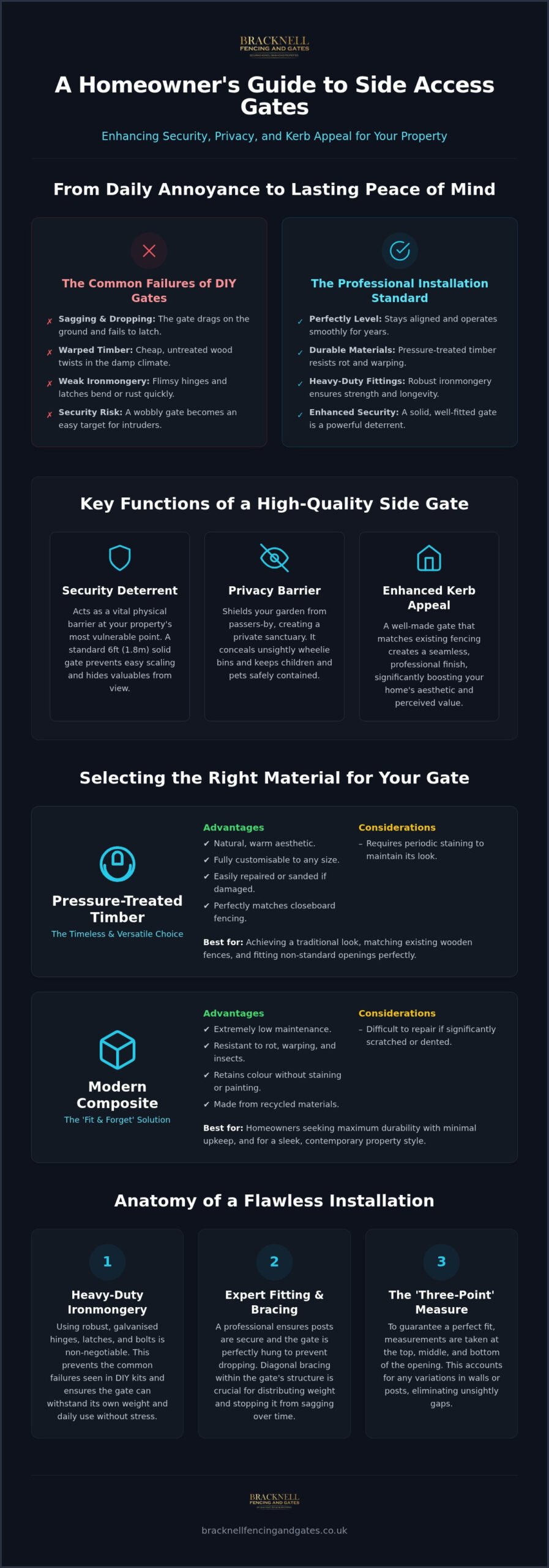
- Understand how a high-quality side gate serves as a vital security deterrent and privacy barrier for your property boundary.
- Compare the long-term durability and maintenance requirements of traditional pressure-treated timber versus modern composite materials.
- Learn the technical requirements for a professional side access gates installation, including how to ensure your gate never sags or drops.
- Identify why heavy-duty ironmongery is essential for preventing the common failures associated with standard DIY gate kits.
- Master the “three-point check” for accurate measuring to ensure a perfect fit between existing wall plates or fence posts.
The Importance of Side Access Gates for Home Security and Privacy
Side access points are frequently the most vulnerable part of a property boundary. Whilst front doors are often visible to the street and neighbours, side paths provide a secluded entry point that intruders can exploit under the cover of darkness or high hedges. A professional side access gates installation creates a significant physical and visual barrier that protects your home from unwanted visitors. It sends a clear message that your property is well-defended and difficult to breach.
Beyond security, these gates serve as a privacy shield for your outdoor living space. They hide unsightly wheelie bins and ensure your garden remains a private sanctuary for your family. The Importance of Side Access Gates in modern home design cannot be overstated; they act as the final piece of the puzzle in a secure perimeter. A solid, lockable gate prevents passers-by from peering into your garden, keeping your children and pets safe within a contained area.
Deterring Intruders with Solid Construction
Security starts with height and material choice. We recommend a standard 6ft (1.8m) gate to prevent easy scaling. A solid timber gate, rather than an open-slat decorative style, removes foot-holds and blocks the view of your garden’s contents. This “no-climb” approach is essential for keeping high-value items like mountain bikes or expensive garden machinery out of sight. When you choose a heavy-duty wooden side gate, you’re reinforcing the side of your house with a deterrent that’s difficult to bypass without making significant noise.
Enhancing Kerb Appeal and Property Value
A gate shouldn’t look like an afterthought. It should feel like a natural extension of your property’s boundary. Many homeowners in Bracknell choose to match their new gate with a closeboard fencing installation to create a uniform, professional finish. This consistency significantly improves kerb appeal and can even boost property value by demonstrating that the home is well-maintained and secure.
Professional timber gates age much better than the thin, mass-produced alternatives found in DIY stores. We use pressure-treated timber that resists rot and retains its structural integrity through the unpredictable Berkshire weather. A well-fitted gate doesn’t just look better; it stays level and operates smoothly for years. This avoids the sagging and dragging that often plagues cheaper, DIY-fitted options that haven’t been properly braced.
Selecting the Right Materials: Timber vs Composite Side Gates
Choosing the right material for your side access gates installation depends on your priorities for aesthetics, budget, and long-term maintenance. In Bracknell, we experience damp winters and humid summers, which means any material used must be durable enough to withstand constant moisture and temperature shifts. Traditional timber remains the most popular choice for its natural warmth and versatility, but modern composite is quickly gaining ground for homeowners who prefer a “fit and forget” approach.
Pressure-treated timber is the foundation of a long-lasting gate. Unlike untreated wood often found at high-street retailers, our timber is infused with preservatives that penetrate deep into the grain. This process is vital for Selecting the Right Materials that can handle the British weather without rotting. Wooden gates offer a unique advantage in terms of repairability; if a board is accidentally damaged, it can be replaced or sanded down. This is much harder to achieve with metal or plastic alternatives that often require a full replacement if they become dented or scratched.
The Timeless Appeal of Wooden Side Gates
Wooden gates, particularly those using feather edge or closeboard designs, provide a robust and heavy-duty feel that matches the majority of Berkshire boundaries. These styles use thick, overlapping boards that create a solid, secure barrier. One of the biggest benefits of timber is customisation. If your side access is a non-standard width, a wooden gate can be built to the exact millimetre. This ensures a tight fit that eliminates the gaps often found with “off-the-shelf” kits. Whilst timber does require periodic staining to look its best, many homeowners find the traditional aesthetic worth the minimal effort. If you’re also considering upgrading your front entrance, our guide to wooden driveway gates in Berkshire covers the full range of styles and structural features available for a cohesive property boundary.
Composite Side Gates for Low-Maintenance Security
Composite gates are an excellent alternative if you want the look of wood without the upkeep. These are made from a blend of recycled wood fibres and plastic, making them completely resistant to rot, warping, and insect damage. The colour is baked into the material during manufacturing, so it won’t fade or peel like paint. They are incredibly easy to clean with just a quick wipe down. If you’re looking for a modern finish that stays looking new for decades, you can browse our composite fencing and gate options to find the right match for your home.
Ultimately, the choice comes down to your budget and how much time you want to spend on garden chores. Timber is generally more cost-effective at the start, whilst composite offers a lower total cost of ownership over its lifespan. Both materials provide the security and privacy needed for a professional installation that stands the test of time.
Essential Security Features and Heavy-Duty Ironmongery
The ironmongery you choose is the backbone of your gate’s performance. In many DIY projects, hardware is the first point of failure. Using standard door hinges or lightweight latches on a heavy wooden gate leads to sagging within months. A professional side access gates installation requires hardware that can support the substantial weight of pressure-treated timber whilst resisting the damp Berkshire climate. High-quality ironmongery ensures that your gate remains easy to use and difficult to breach.
Rust prevention is a major consideration for any outdoor installation. We always recommend galvanised steel hardware. This process involves coating the steel in a protective layer of zinc, which prevents the metal from corroding when exposed to rain. Whilst powder-coated black hardware is popular for its traditional look, it’s vital to ensure it has a galvanised base. Without this, the paint will eventually chip, leading to unsightly rust streaks that can rot the surrounding timber.
Choosing the Right Hinges and Latches
Heavy-duty tee hinges are essential for distributing weight across the gate’s horizontal braces. We frequently use adjustable hinges because timber is a natural material that moves. As the seasons change, wood expands and contracts. Adjustable hinges allow us to tweak the gate’s alignment with a simple spanner, ensuring it never catches on the post or frame. This small technical detail prevents the long-term structural damage caused by forcing a misaligned gate shut.
When it comes to latches, ring latches offer a more robust solution than traditional Suffolk latches. They provide a solid grip and are much harder to manipulate from the outside. We also pay close attention to the fixings used. Using screws that are too short is a common mistake; we use heavy-gauge, stainless steel screws that bite deep into the frame to ensure the hardware never pulls away under tension.
Advanced Locking Mechanisms
For maximum security, a simple bolt is rarely enough. Key-lockable bolts, such as the Gatemate style, provide a high level of protection by allowing you to lock and unlock the gate from both sides. This effectively turns your side entrance into a secure door, offering much better peace of mind than a standard padlock. These locks are designed specifically for thick timber and are resistant to common bypass techniques used by intruders.
If you prefer traditional bolts, we recommend a “two-bolt” system. Placing a padbolt at the top and bottom of the gate prevents it from being levered or kicked in at the corners. For homeowners interested in modern technology, we can also integrate smart locks. These allow you to monitor your side access via a smartphone, providing an extra layer of security that complements the physical strength of a well-built wooden gate. If you’re looking to extend this level of protection to your vehicle entrance, our guide to security gates for driveways in Berkshire covers the essential features and planning considerations for a fully secured property perimeter.
Preparing for Installation: Measuring and Structural Requirements
Accurate preparation is the foundation of a successful side access gates installation. Many homeowners make the mistake of taking a single measurement and assuming their walls or posts are perfectly vertical. We use a “three-point check” for width, measuring at the top, middle, and bottom of the opening. This identifies any tapering in the brickwork or fence line. If the gap narrows at any point, the gate must be sized to fit the smallest dimension to avoid catching on the frame.
Ground clearance is another critical factor that DIY guides often overlook. A gate needs enough space to swing freely without scraping against uneven paving or catching on rising ground. We typically allow for a 50mm gap at the bottom. This prevents water from being trapped against the timber grain, which would otherwise lead to premature rot. Before we begin any digging, it’s also essential to check for underground services like water pipes or electrical cables that often run along the side of Berkshire homes.
Setting the Foundation: Gate Posts
A gate post undergoes significantly more stress than a standard fence post because it must support the constant swinging weight of the timber. For a secure installation, posts should be set at least 2ft (600mm) deep into the ground with high-strength concrete. Whilst wooden posts offer a traditional look, they must be properly pressure-treated to survive the local soil conditions. If you’re attaching the gate to a house wall, we use a heavy-duty wall plate. This timber beam is bolted directly into the brickwork, providing a stable surface for the hinges and ensuring the weight doesn’t pull on individual bricks.
Bracing and Frame Construction
The internal structure of the gate determines how well it will resist sagging over time. We utilise a “Z-frame” bracing pattern, which transfers the weight from the latch side down to the bottom hinge. This diagonal support is what keeps the gate square and prevents the dreaded “drop” that makes latches impossible to line up. For premium installations, mortise and tenon joints provide superior structural integrity compared to simple screwed frames. These interlocking joints are far more resistant to the twisting forces caused by wind and heavy use.
Finally, we always ensure the gate opens inwards towards your property. This is a matter of both security and legal compliance; a gate should never swing out across a public footpath or bridleway. Opening inwards also keeps the hinges on the protected side of the boundary, making it much harder for an intruder to tamper with the hardware. If you’re ready to upgrade your home’s security, you can get a professional quote for your side access gate from our local team today.
Professional Side Access Gate Installation in Bracknell
Choosing a local specialist for your side access gates installation ensures that your project is handled by someone who understands the specific challenges of the Berkshire landscape. From the clay-heavy soils found in parts of Bracknell to the gusty winds that sweep across open gardens, local knowledge is invaluable. We don’t just hang a gate; we engineer a solution that stands firm against the elements. Our team takes pride in being a “safe pair of hands” for homeowners, providing a service that focuses on longevity and structural integrity.
A professional installation takes the guesswork out of property security. On the day of fitting, we arrive with all the necessary tools and high-grade materials to complete the job efficiently. We understand that your time is valuable, so we work methodically to ensure the site is secure by the time we leave. Once the gate is hung, we perform a series of swing checks and latch tests to guarantee a smooth operation. We also provide advice on post-installation care, such as the best times of year to apply a fresh coat of UV-resistant oil to keep the timber supple and waterproof.
The Bracknell Fencing and Gates Standard
Our commitment to quality starts with the timber we select. We only use heavy-duty, pressure-treated wood that has been specifically chosen for its resistance to rot and warping. Every gate is perfectly levelled using precision equipment, ensuring that the gap between the gate and the post is uniform from top to bottom. We also maintain a strict clean and tidy site policy. We respect your Berkshire home as if it were our own, meaning we remove all debris and old gate materials, leaving your side path ready for immediate use.
Getting Your Quote
We believe in transparent pricing with no hidden “extras” added on the day. When you book a site survey in the Bracknell area, we provide a detailed, fixed-price quote that covers both materials and labour. This allows you to plan your budget with total confidence. You can also customise your side entrance as part of a wider garden gate installation project, perhaps matching your side gate to a new set of wooden driveway gates in Berkshire or a run of fresh feather edge fencing. Our goal is to provide a seamless transition from your initial enquiry to the final, satisfying click of a perfectly fitted latch.
Secure Your Property with a Professional Side Entrance
A side gate is far more than just a boundary marker; it’s a vital security feature that protects your family and garden. By focusing on solid timber construction and heavy-duty ironmongery, you can avoid the sagging and rot that often affect cheaper, mass-produced alternatives. Whether you opt for the natural look of pressure-treated wood or the durability of composite, the quality of the fitting determines how well your gate will perform over time.
Choosing a professional side access gates installation ensures that every technical detail, from ground clearance to frame bracing, is handled correctly. As local Berkshire experts, we use heavy-duty timber as standard and include professional-grade ironmongery to provide a robust, long-lasting finish. We take pride in being a dependable choice for homeowners who value craftsmanship and security.
If you’re ready to enhance your home’s kerb appeal and privacy, we’re here to help. Request a fixed-price quote for your side gate installation in Bracknell today. Let us help you create a secure, attractive entrance that stands the test of time.
Frequently Asked Questions
Do I need planning permission for a new side access gate in Bracknell?
Planning permission is usually not required for a standard side access gate in Bracknell, provided it doesn’t exceed 2 metres in height. However, different rules apply if your home is a listed building or located in a conservation area. If the gate opens directly onto a public right of way, you must also comply with specific council regulations. We always recommend checking with Bracknell Forest Council if you have any doubts about your specific location.
How long does a professional side access gate installation take?
A professional side access gates installation typically takes between 4 and 6 hours to complete from start to finish. This timeframe includes the removal of any old gate, setting new posts in concrete, and the precise hanging of the timber frame. More complex projects involving new brickwork wall plates or significant ground clearance adjustments may take a full working day. We always aim to leave your property secure by the time we finish.
Can you install a side gate if the ground is uneven or sloping?
We can certainly install a side gate on uneven or sloping ground by utilising specific fitting techniques. For sloping paths, we often “step” the gate or adjust the bottom clearance to ensure it swings freely without catching. In some cases, we might recommend a bespoke frame that follows the contour of the ground. Our site survey will identify these challenges early, ensuring the final result is both functional and visually level.
What is the best wood for a side gate to prevent rotting?
Pressure-treated softwood is the most cost-effective and durable choice for the Berkshire climate. This timber undergoes a high-pressure treatment process that forces preservatives deep into the wood grain to prevent rot and insect damage. For those seeking premium longevity, hardwoods like iroko or oak are excellent alternatives. Regardless of the wood type, professional treatment is essential to ensure your gate survives damp winters without twisting or decaying.
Is it better to hang a gate on a wooden post or a wall plate?
Choosing between a wooden post and a wall plate depends entirely on your existing boundary structure. If you have a solid brick wall, a timber wall plate is often the most secure option as it’s bolted directly into the masonry. This prevents the weight of the gate from pulling on individual bricks. If no wall is present, we use heavy-duty wooden posts set deep in concrete to provide a stable foundation for the hinges.
How much wider should the opening be than the actual gate?
The opening should typically be approximately 10mm to 20mm wider than the actual gate. This small gap allows for the natural expansion and contraction of the timber during different seasons whilst providing enough room for the hinges and latch to operate smoothly. If the gap is too tight, the gate will likely catch in damp weather. If it’s too wide, the security of the latch mechanism could be compromised.
Can you match my new side gate to my existing closeboard fencing?
Yes, we specialise in matching new gates to existing closeboard or feather edge fencing. Because we use the same high-quality pressure-treated timber boards found in our fence panels, we can create a seamless transition across your boundary. This uniform look significantly improves your home’s kerb appeal. During your side access gates installation, we ensure the height and board spacing perfectly align with your current fence line for a professional finish.
What maintenance does a wooden side gate require each year?
A wooden side gate requires an annual check-up to maintain its structural integrity and appearance. We recommend applying a fresh coat of UV-resistant wood oil or stain every 12 months to prevent the timber from drying out or silvering. You should also check the ironmongery for any signs of rust and lubricate the hinges and latches with a light oil. This simple routine ensures your gate continues to operate smoothly for years.