
What if the most effective deterrent against vehicle theft in Bracknell isn’t a high-tech alarm, but installing robust security gates for driveways? Many Berkshire homeowners feel increasingly uneasy as local crime statistics show that 19% of household thefts involve items taken from outside the home. You want to secure your property, but the fear of choosing an ugly, high-maintenance structure or falling foul of local planning laws often causes hesitation.
We understand that your home is your sanctuary. It’s entirely possible to achieve peace of mind without sacrificing the kerb appeal of your property. This guide provides a clear, professional checklist to help you navigate the process from start to finish. You’ll learn about the most durable timber options, current planning permission thresholds, and the essential features that keep a gate functioning for years. We’ll also cover the specific 2026 regulations for Bracknell Forest, ensuring your new installation is both legal and reliable. By the end, you’ll have a practical roadmap to finding a local specialist who can provide a safe pair of hands for your project.
Key Takeaways
- Understand how high-quality security gates for driveways provide a psychological deterrent and prevent property “casing” with solid infill panels.
- Evaluate the security benefits of heavy-duty timber versus metal to ensure your gate withstands impact while maintaining your home’s kerb appeal.
- Learn the technical differences between sliding and swing gates to determine which mechanism offers the most resistance against forced entry.
- Navigate UK planning permission rules with ease, focusing on the specific height restrictions for gates adjacent to highways and footpaths.
- Recognise why professional installation and deep-set posts are vital for ensuring your security investment remains stable in Berkshire soil.
What Defines High-Security Gates for Driveways?
Security gates for driveways are often misunderstood as simple boundary markers. In reality, they serve as the primary defensive layer for your Berkshire home. A high-security gate works on two levels: it presents a physical obstacle that requires significant effort to bypass and sends a psychological signal that your property is a difficult target.
The Psychology of a Secure Entrance
A well-maintained, robust gate suggests a homeowner who takes security seriously. In areas like Bracknell, where concerns about vehicle theft are rising, first impressions matter. A flimsy or weathered gate tells a potential intruder that the rest of the property’s security might be equally neglected. True security gates are designed to be imposing without looking like a prison entrance. A “Safe Home” starts at the kerbside, and a professional installation ensures your entrance looks both welcoming to guests and daunting to trespassers.
Physical Strength vs. Visual Privacy
The “Privacy Gap” is the vulnerability created when an open-design gate allows passers-by to see exactly which vehicles are on your driveway and whether your home appears occupied. While metal railings offer durability, they often lack this vital visual protection. Solid-boarded timber gates, such as those featured in our wooden driveway gates Berkshire guide, provide a total visual block. This prevents “casing”, which is the practice of criminals observing a property to plan a future theft. Heavy-duty timber offers excellent impact resistance, making it much harder to force through than many people realise.
You shouldn’t view a gate as an isolated item because it’s part of a wider perimeter system. A heavy-duty gate attached to weak fence panels or shallow posts is easily compromised. We ensure that the surrounding fencing, such as our closeboard or feather edge panels, matches the gate’s resilience. If the fence is the “wall”, the gate is the “vault door”; both must be equally strong to be effective.
When choosing security gates for driveways, height and ground clearance are major factors in preventing unauthorised access. A gate that is too low is easily vaulted by an agile intruder. Conversely, a gate with too much ground clearance allows tools or even people to pass underneath. Ideally, a security gate should sit as close to the ground as the driveway’s level allows while reaching a height that requires a ladder to scale. We always consider the UK’s 1-metre and 2-metre planning rules to ensure your security remains both effective and legal.
Choosing the Right Material: Timber vs. Metal for Security
Selecting the right material for security gates for driveways requires balancing physical strength with long-term durability. While some competitors suggest aluminium is the only modern choice, we find that heavy-duty timber remains a top contender for Berkshire properties. The decision often comes down to how you want the gate to interact with your perimeter and the local environment. A gate that looks flimsy won’t deter anyone; it needs to look and feel substantial.
The Advantages of Bespoke Wooden Gates
Heavy-duty wooden driveway gates Berkshire homeowners often choose are built with significant thickness. We use pressure-treated timber that resists rot and provides a solid, high-impact barrier. Unlike thin metal bars, a solid wooden gate is difficult to climb and impossible to see through. This material allows for complete customisation. You can match your gate perfectly to a closeboard fencing installation, creating a unified and secure boundary that looks intentional. The natural weight of timber also makes it incredibly difficult to force open without heavy equipment.
Metal and Wrought Iron Considerations
Metal gates are often selected for their longevity and “see-through” security. This is useful if you need to monitor the street from your driveway. However, wrought iron and aluminium lack the privacy that many Bracknell homeowners desire. If you choose metal, ensure the hardware is powder-coated to prevent rust in our damp climate. Keep in mind that metal gates frequently require additional privacy screening or integrated panels to prevent “casing” by intruders. This can add complexity to the final build and may affect the gate’s wind resistance.
Maintenance is a non-negotiable part of owning a security gate. The British weather is relentless. Timber requires a high-quality UV-resistant oil or stain every few years to prevent warping or splitting. Metal requires checks for chips in the paint that could lead to structural weakness through corrosion. Investing in premium materials from the start prevents the gate from sagging under its own weight. A sagging gate isn’t just an eyesore; it’s a security risk because the locking mechanisms will no longer align correctly. If you’re unsure which material suits your driveway’s slope or soil type, consulting a local specialist can help you avoid these common pitfalls.
Swing vs. Sliding Gates: Which is More Secure?
Deciding between a swing or sliding mechanism is a critical step in planning security gates for driveways. While your choice is often dictated by the available space at your Berkshire property, each system offers distinct defensive advantages. A gate’s security is only as good as its resistance to being pushed, pulled, or lifted off its mountings. You need a solution that stands firm against both the elements and potential intruders.
The Sliding Gate Advantage
Sliding gates are widely considered the more secure option against forced entry. Because the gate leaf is held within a continuous track or a cantilever system, it’s physically impossible to “ram” or push the gate inwards. This mechanical lock-in provides a high level of resistance that swing gates can’t always match. They are particularly effective for compact Bracknell driveways where there isn’t enough depth for a wide swing arc. You must ensure the track remains clear of debris like gravel or autumn leaves. A simple obstruction can cause the gate to stick open, which immediately compromises your home’s perimeter.
Securing Traditional Swing Gates
Swing gates remain the traditional choice for many Berkshire homes due to their classic appearance and ease of manual operation. To make them truly secure, you must address the “meeting point” where the two leaves join. Without reinforcement, this is a natural weak spot that can be exploited. We recommend using heavy-duty hinges that can’t be unscrewed or lifted, alongside substantial “drop bolts” that lock deep into a ground socket. For those looking for structural advice on securing smaller access points, our guide on garden gate installation Bracknell explains the importance of frame rigidity and hinge placement in detail.
The ultimate strength of any gate depends entirely on the posts supporting it. For security gates for driveways, we use either deep-set concrete posts or heavy-duty 8-inch timber posts. If a post shifts or leans even slightly, the gate’s lock or latch won’t line up correctly. This creates a gap that can be easily exploited with a crowbar or lever. In Berkshire’s varied soil conditions, the foundation of these posts is the difference between a gate that stays secure for decades and one that becomes a liability within a few seasons. We ensure every post is set to a depth that prevents frost heave and movement, providing a “safe pair of hands” for your property’s primary defence.
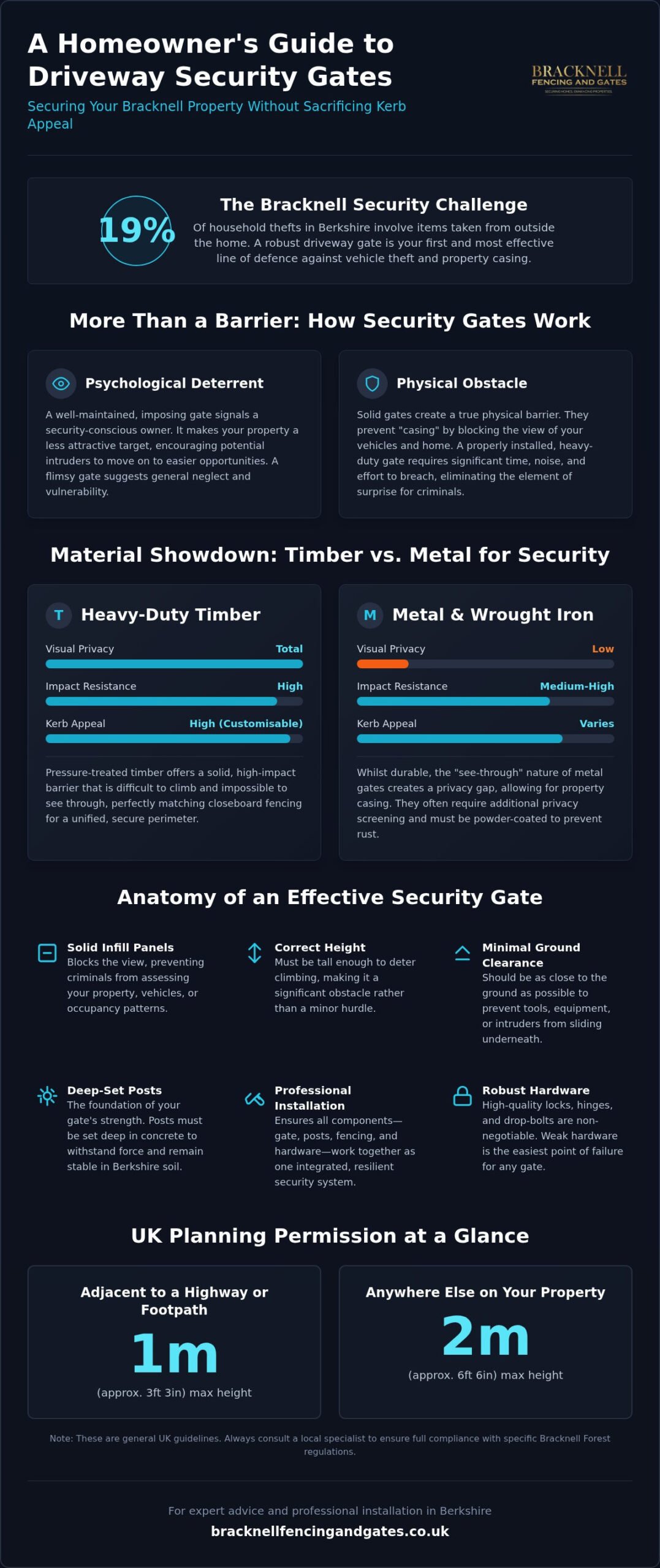
The Ultimate Driveway Security Gate Checklist
Installing security gates for driveways is a significant investment in your home’s safety. To ensure no detail is overlooked, we have compiled a methodical checklist. This process moves from legal compliance to the final technical integration of your security system. Precision is vital. A gate that isn’t perfectly level or posts that aren’t deep enough will eventually fail, compromising your property’s primary defence.
- Check Planning Permission: In the UK, you generally don’t need permission for gates under 1 metre high next to a highway, or 2 metres elsewhere.
- Assess the “Weakest Link”: Your driveway gate is only effective if your side gates and fencing match its strength.
- Choose Your Locking Mechanism: Select a system that balances convenience with resistance to tampering.
- Lighting and Surveillance: PIR motion-sensor lights and CCTV cameras should be positioned to cover the blind spots around your entrance.
- Professional Installation: Expert fitting ensures that heavy gates remain stable and locks align perfectly over time.
Access Control and Locking Systems
A high-security gate requires more than a simple padlock. While padlocks are cost-effective, they are easily bypassed with bolt croppers. Integrated digital keypads or intercom systems allow you to verify visitors before they ever set foot on your land. It’s also essential to secure your side access gates with the same level of rigour. If a burglar can’t get through the driveway, they will immediately look for a secondary entry point. We recommend matched locking systems for a seamless and secure perimeter.
Planning and Legal Requirements in Bracknell
UK planning laws are strict regarding structures fronting a highway. If your driveway opens onto a public road or footpath, the 1-metre height limit is a critical boundary. Exceeding this without permission can lead to enforcement action. For a householder planning application in England, the fee is currently £258 in 2026. You must also consider sightlines. This ensures you have a clear view of pedestrians and other vehicles when exiting onto busy Berkshire roads. If your project is complex, applying for a Certificate of Lawful Development provides written proof that your security gates for driveways are legal, which is helpful when selling your home.
If you’re ready to secure your property with a bespoke solution, contact our Bracknell team for a professional site assessment.
Professional Installation: Securing Your Investment in Bracknell
Professional installation is the final, most critical step in securing your home. Even the most expensive security gates for driveways will fail if they are not mounted with absolute precision. A gate that sags by just a few millimetres can prevent a deadlock from engaging, rendering the entire system useless. We take a “safe pair of hands” approach, ensuring that every component is installed to withstand both the weight of the timber and the unpredictable British weather.
The foundation of any secure entrance lies beneath the surface. Berkshire soil can vary from heavy clay to sandy pockets, which affects how posts settle over time. We use deep-set posts, often reinforced with extra concrete, to provide a stable anchor that resists frost heave and ground movement. This level of groundwork is something national DIY kits often overlook; however, it is essential for the long-term reliability of your investment.
The Installation Process Explained
Our process begins with a comprehensive site survey. We don’t just measure the gap; we assess the ground levels and the drainage of your driveway. Installing security gates for driveways on a slope requires specialised hinges to ensure the gate clears the ground without leaving a massive security gap at the bottom. Once the posts are set and the concrete has cured, we hang the gate with heavy-duty, adjustable galvanised ironmongery. This allows for fine-tuning, ensuring the latch aligns perfectly every time you close it. Whether you have a traditional gravel drive or a modern paved entrance, we ensure the finish is clean and the operation is smooth.
Why Bracknell Fencing and Gates?
Choosing a local specialist means you have a point of contact who understands the specific needs of Berkshire homeowners. We don’t believe in high-pressure sales or “one-size-fits-all” solutions. Instead, we focus on honest craftsmanship and durable materials that offer genuine peace of mind. Our reputation in Bracknell is built on being reliable, methodical, and transparent about what works best for your specific property.
We pride ourselves on providing a steady, professional service that respects your time and your property. If you want an entrance that combines traditional British kerb appeal with modern defensive strength, we are here to help. Contact us today for a free quote on your driveway security project and take the first step toward a more secure home.
Secure Your Berkshire Perimeter Today
Choosing the right security gates for driveways is about more than just picking a style; it’s about creating a robust first line of defence for your home. We’ve explored how solid timber provides essential visual privacy and how the right mechanical setup, whether sliding or swing, ensures your property remains a difficult target. By following our checklist and understanding local planning rules, you can avoid common pitfalls and ensure your installation is both legal and effective.
At Bracknell Fencing and Gates, we bring years of local expertise to every project. We use high-quality, pressure-treated timber to ensure maximum durability against the British weather. Our professional installation process guarantees that your gate won’t sag and your locks will always align perfectly. If you’re ready to enhance your home’s protection and kerb appeal, we’re here to provide a safe pair of hands for your project. Request a Free Quote for Your Driveway Security Gates today. Let’s work together to give your family the peace of mind they deserve.
Frequently Asked Questions
Do I need planning permission for security gates on my driveway?
You generally don’t need planning permission if your gate is under 1 metre high next to a highway or 2 metres high elsewhere on your property. However, if your home is a listed building or sits within a conservation area, stricter rules apply. In 2026, the fee for a householder planning application in England is £258. It’s always best to check with Bracknell Forest Council to ensure your design complies with local regulations.
Which is more secure: a wooden gate or a metal gate?
Wooden gates offer superior visual security because their solid infill panels prevent intruders from “casing” your property. Heavy-duty timber is difficult to scale and provides excellent impact resistance. While metal gates are durable, they often have gaps that allow people to see your vehicles and home. For security gates for driveways, a solid-boarded timber design often provides the best balance of privacy and physical protection.
How much do security gates for driveways typically cost to install?
The total cost depends on several factors, including the material choice, the width of your entrance, and the complexity of the groundworks. Manual gates are generally more affordable than automated systems, which require specialised motors and safety sensors. While costs vary across Berkshire, investing in professional installation is vital. This prevents issues like “gate sag”, which can eventually cause locks to misalign and compromise your home’s primary line of defence.
Can I automate my existing driveway gates for better security?
You can often automate existing gates if they are structurally sound and the hinges are in good condition. Adding an automation system enhances security by ensuring your entrance is never accidentally left open. You might also consider integrating smart technology, which allows you to control the gate via a smartphone app. This provides real-time access notifications and allows you to manage visitors even when you aren’t at home.
What is the best height for a residential security gate?
A height of 1.8 to 2 metres is the most effective for residential security as it’s difficult to scale without a ladder. You must remember the 1-metre height limit for gates adjacent to public footpaths or roads to avoid planning issues. Taller gates provide better privacy and create a stronger psychological deterrent. We ensure your gate height provides maximum protection while remaining compliant with UK planning laws and safety standards.
How do I maintain my wooden security gate to prevent it from rotting?
Regular treatment with a high-quality UV-resistant oil or stain is the best way to protect timber from the British weather. You should apply a fresh coat every two to three years to maintain the wood’s integrity. It’s also important to check the ironmongery for signs of wear and lubricate the hinges twice a year. This keeps the operation smooth and ensures the locking mechanisms stay perfectly aligned for years to come.
Should I choose a sliding or a swing gate for a narrow driveway?
Sliding gates are the ideal choice for narrow driveways or properties with steep slopes where a swing arc isn’t practical. They slide along a track or cantilever system, requiring very little depth to operate. This mechanism is also harder to force open compared to traditional swing designs. You must keep the track clear of debris like gravel or leaves to ensure the gate never sticks in an open position.
Will a security gate increase the value of my Berkshire property?
High-quality security gates for driveways can increase property value by improving kerb appeal and providing peace of mind. With the average UK garden containing items worth around £2,000, buyers often prioritise secure perimeters. Statistics show that 19% of household thefts involve items taken from outside the property, making a secure entrance a significant selling point. A well-installed gate signals that a home is well-maintained and takes security seriously.