
Your driveway gate is the only physical barrier between a busy Berkshire road and your most valuable assets, yet many homeowners treat it as an afterthought until the timber starts to sag. You likely want an entrance that looks prestigious without requiring a bank holiday’s worth of maintenance every few months. It’s frustrating when a significant investment loses its shape or fails to latch properly after just one damp winter. We understand that security and kerb appeal should go hand in hand, especially when you are protecting expensive vehicles and family privacy.
This guide explains how to choose, install, and maintain the high-quality wooden driveway gates berkshire properties deserve. You’ll discover why certain timber species outperform others in our local climate and how professional installation prevents the common pitfalls of warping and dragging. We will cover everything from classic aesthetic styles to the heavy-duty structural features that ensure your gates operate smoothly for years to come. By the end of this article, you will have the confidence to invest in a timber entrance that adds genuine value and lasting security to your home.
Key Takeaways
- Understand the balance between visual prestige and home security to create an entrance that is both welcoming and highly protective.
- Identify the most stable timber designs to ensure the wooden driveway gates Berkshire weather conditions often test remain structurally sound and warp-free.
- Evaluate the essential heavy-duty ironmongery and locking mechanisms required to keep wide-span gates secure and easy to operate.
- Discover why professional installation is vital for managing technical factors like wind loading and precise post depth to prevent dragging.
- Learn the specific maintenance routines and weatherproofing treatments needed to preserve the appearance and integrity of your timber for years.
The Value of Investing in Quality Wooden Driveway Gates for Your Berkshire Home
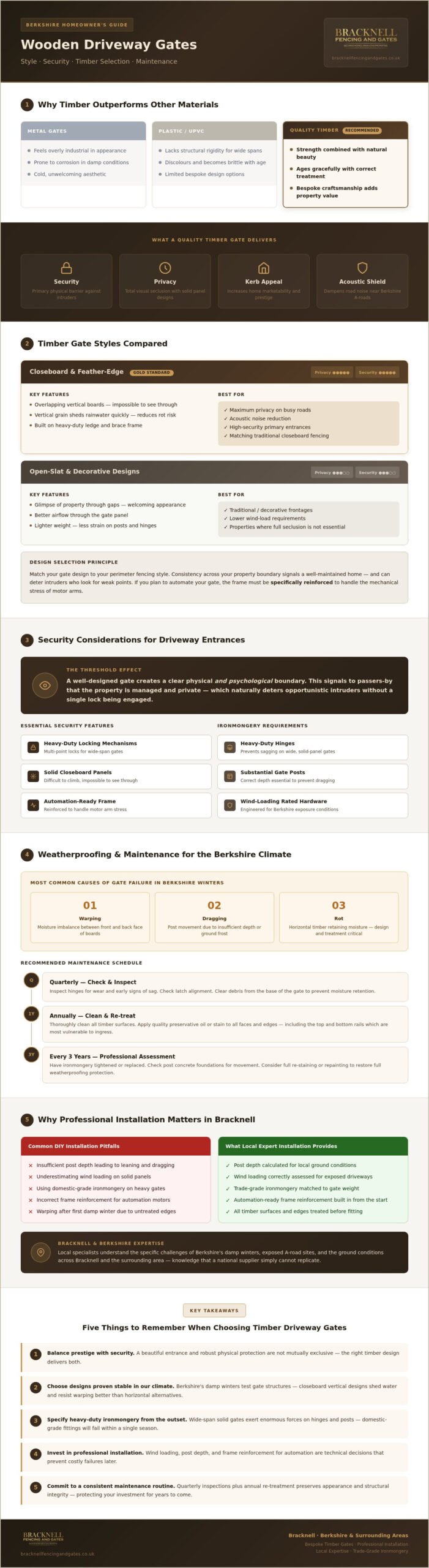
A driveway gate does more than mark a property line. It serves as the primary architectural statement for your home, acting as the first point of contact for every visitor. In modern property design, the wooden driveway gates berkshire homeowners choose often reflect a commitment to both security and traditional craftsmanship. A well-designed gate creates a clear physical and psychological boundary. This “threshold effect” signals to passers-by that the property is managed and private, which naturally deters opportunistic intruders.
Timber remains the preferred material across the county for several practical reasons. While metal can feel overly industrial and plastic often lacks structural rigidity, high-quality timber offers a unique balance of strength and natural beauty. It is a versatile material that ages gracefully, provided it is sourced and treated correctly for the local climate. Beyond the immediate visual impact, a bespoke timber entrance is a tangible asset. It often increases the overall marketability of a home, providing a sense of completion and kerb appeal that many buyers look for in the local market.
Curb Appeal and First Impressions
First impressions are formed in seconds. Choosing a gate style that complements your home architecture is essential for a cohesive look. Many local properties benefit from the natural warmth of timber, which softens the appearance of brickwork and stone. You can create a seamless aesthetic by matching your entrance with a professional closeboard fencing installation. This consistency ensures that your entire boundary looks deliberate and well-maintained, rather than a collection of mismatched sections.
Privacy and Acoustic Benefits
Privacy is a luxury, especially for homes located near busy Berkshire A-roads or town centres. Solid timber gates act as an effective acoustic barrier, helping to dampen the drone of passing traffic and pedestrian noise. If your goal is to create a quiet sanctuary, solid-panel designs are far superior to open-slat versions. While open-slat gates offer a glimpse of the property and better airflow, solid panels provide total visual seclusion. This allows you to use your front garden or driveway as a private extension of your living space without feeling overlooked.
Choosing the Right Style: A Comparison of Timber Gate Designs
Selecting the correct design for wooden driveway gates berkshire homeowners often find challenging because the choice impacts more than just aesthetics. You must consider the weight of the timber, the wind resistance of the panel, and how the gate will be operated daily. A heavy, solid gate provides excellent security but requires substantial posts and heavy-duty hinges to prevent sagging over time. If you plan to automate your entrance, the frame must be specifically reinforced to handle the mechanical stress of the motor arms. We recommend choosing a style that balances physical strength with the practicalities of your specific driveway layout.
Most UK driveway gates fall into two categories: high-privacy solid panels or decorative open-top designs. Your choice should ideally match the rest of your property boundary to create a unified look. For instance, if your perimeter uses traditional fencing, a gate with similar timber patterns will look far more professional than a clashing modern style. Consistency across your property boundary signals a well-maintained home and can even deter intruders who look for weak points in a perimeter.
Closeboard and Feather Edge Driveway Gates
Closeboard construction is widely regarded as the gold standard for driveway entrances where privacy is the priority. These gates use thick vertical boards that overlap, creating a solid barrier that is difficult to climb and impossible to see through. The vertical orientation of the boards is a functional choice; it allows rainwater to run off quickly, which significantly reduces the risk of rot compared to horizontal designs. These gates are exceptionally strong because they are built around a heavy-duty ledge and brace frame. If you are upgrading your main entrance, you might also consider a matching side access gates installation to maintain a consistent security profile around your home.
Decorative and Slatted Gate Options
For more contemporary Berkshire homes, slatted or hit and miss designs offer a sleek, modern alternative. These styles allow some light and air to pass through, which is particularly useful for properties in windy or exposed locations. By reducing wind resistance, these gates put less strain on the gate posts during winter storms. You can also opt for decorative tops, such as a swan neck curve or an integrated trellis, to soften the visual impact of a large driveway barrier. While these designs offer slightly less privacy than closeboard, they provide a more open and welcoming feel to the front of your property. You can explore our full range of driveway gate styles to see which design best fits your home’s character.
Prioritising Security and Aesthetics: Key Considerations for Driveway Entrances
Security is the primary driver for most homeowners investing in wooden driveway gates berkshire. While the appearance of the timber creates the first impression, the structural integrity of the entrance provides the real protection. A gate is only as secure as its weakest component. This means you must look beyond the surface of the wood and evaluate the frame, the gate posts, and the ironmongery. Modern security often involves a layered approach. You can easily integrate physical timber barriers with technology like smart intercoms or CCTV cameras mounted directly onto the gate posts. This combination provides a physical obstacle and a clear visual warning to anyone approaching your property. For a comprehensive overview of what makes an entrance truly secure, our security gates for driveways checklist covers every essential feature Berkshire homeowners should consider.
The height of your gate plays a dual role in security and legal compliance. Higher gates offer better privacy and are harder to climb, but they are subject to strict UK planning regulations. Generally, a gate adjacent to a highway cannot exceed one metre in height without planning permission. For other boundaries, the limit is typically two metres. We always recommend checking with your local Berkshire council before finalised your design to ensure your new entrance meets all visibility and safety requirements.
Heavy-Duty Hardware and Hinges
Driveway gates are heavy, structural elements that require specialised ironmongery to function safely over many years. Standard garden gate hinges are not sufficient for the weight and wind loading of a wide-span driveway entrance. We utilise heavy-duty adjustable hook and band hinges for every installation. These allow for precise fine-tuning if the timber expands or contracts with the seasons, preventing the gate from dragging on the ground or failing to latch.
- Heavy-duty drop bolts: These secure each leaf into the ground to prevent the gate from being forced open by high winds or intruders.
- Central locking bars: A lockable long-throw bolt provides a significantly higher level of security than a standard thumb latch.
- Galvanised finishes: This coating prevents corrosion, ensuring the hardware remains structurally sound in the damp UK climate.
Visual Deterrence and Property Boundaries
A robust, well-maintained entrance serves as a powerful visual deterrent. When an intruder sees substantial timber and high-quality fittings, they recognise that the property is well-protected. The anchoring of these gates is just as important as the gates themselves. We use oversized timber posts, usually 150mm or 200mm square, to provide a stable foundation. These posts are set deep into the ground with professional-grade concrete to ensure they do not lean under the constant weight of the swinging leaves. A solid boundary signals a managed home, which is often enough to encourage opportunistic thieves to move on.
Ensuring Longevity: Weatherproofing and Maintenance for the Berkshire Climate
The damp climate across the Thames Valley and surrounding Berkshire areas is the primary cause of timber degradation. Constant exposure to moisture and fluctuating temperatures can cause untreated wood to swell, split, or rot prematurely. To get the best performance from wooden driveway gates berkshire properties require, you must understand the difference between structural protection and aesthetic maintenance. A gate that looks good on day one won’t necessarily stay that way after three British winters without the right preparation and care.
Wood is a natural material that constantly breathes. It expands in the winter and contracts in the summer. This movement is normal, but left unmanaged, it leads to structural failure. Identifying early signs of movement, such as boards that have slightly shifted or latches that no longer line up, is essential. Catching these small changes early allows you to make minor adjustments before they turn into expensive repairs. We recommend a full visual inspection every six months to ensure the timber remains healthy and the operation stays smooth.
Pressure Treatment vs Surface Staining
Pressure treatment is a non-negotiable standard for any timber that comes into direct contact with the ground, such as your main gate posts. This process involves forcing preservative deep into the wood fibres under high pressure, providing long-term protection against fungal decay. For the gate leaves themselves, surface treatments like oils and stains are essential. While pressure-treated timber is durable, it can still turn grey over time due to UV exposure. Applying a high-quality UV-resistant stain every 18 to 24 months will keep the wood supple and prevent water from soaking into the grain.
- Oil-based stains: These penetrate the wood and allow it to breathe without cracking or peeling like some paints.
- End-grain sealers: Applying a specialist sealer to the top and bottom of the gate boards prevents moisture from being “wicked” up into the timber.
- Cleaning: Removing algae and dirt every spring prevents moisture from being trapped against the wood surface.
Preventing Gate Sag and Warping
Structural failure often starts with the design of the frame rather than the wood itself. Every heavy driveway gate must feature a diagonal brace that runs from the bottom hinge up to the opposite top corner. This brace acts as a structural bridge, transferring the weight of the gate leaf back to the hinge post. Without this, even the most expensive timber will eventually sag under its own weight. Moisture ingress at the end-grain is another common culprit for warping, as it causes uneven expansion across the panel.
You should also perform simple seasonal checks on your hardware. Use a spanner to adjust your heavy-duty hinges if you notice the gates aren’t meeting perfectly in the middle. Keeping the hardware lubricated ensures the wood isn’t under unnecessary stress when the gates open and close. If you want a gate built to withstand the local weather, you can contact us for a durable driveway gate installation that focuses on long-term structural integrity.
Professional Installation: Why Local Expertise Matters in Bracknell
Installing wooden driveway gates berkshire homeowners often find is a task that looks simpler than it is. The technical demands of wide-span timber are significant. A single driveway leaf can easily weigh over 80kg, placing immense constant pressure on the supporting posts. If the post depth isn’t calculated correctly or the concrete mix is too thin, the gate will start to lean within its first year. We calculate the required post size and depth based on the gate’s specific weight and the wind loading of your property. A solid closeboard gate acts like a sail in a gale, and without a professional foundation, the structural stress can snap even thick timber posts.
Local knowledge of Berkshire soil is a vital part of a durable installation. Much of the ground around Bracknell and the surrounding villages consists of heavy clay. This soil type expands and contracts significantly between a wet winter and a dry summer. This movement can shift gate posts that haven’t been anchored with enough concrete or set to the correct depth. In other parts of the county where the soil is sandier, drainage becomes the priority to prevent the base of the timber from sitting in standing water. We adjust our installation methods to suit these specific ground conditions, ensuring your entrance remains stable regardless of the season.
The Installation Process: From Survey to Completion
Every successful project begins with a precise site survey. Driveways are rarely perfectly level, and we must account for the “fall” of the ground to ensure the gates have enough clearance to swing freely without hitting the tarmac. We maintain a tight security gap at the bottom whilst ensuring the operation is effortless. Our standard approach involves setting oversized posts in a substantial volume of professional-grade concrete. Once the posts are cured, we perform the final adjustments on the heavy-duty hinges to achieve a perfect, “no-rub” closure that feels solid and secure every time you use it.
Choosing a Local Berkshire Contractor
Working with a local specialist provides peace of mind that a faceless national firm cannot match. When you evaluate quotes for garden gate installation bracknell or larger driveway projects, look for contractors who offer fixed-price quotes. We provide transparent pricing so you know the exact cost of your project before any work begins. Being based locally means we are always available for future maintenance or adjustments as your timber settles. We take pride in being a “safe pair of hands” for your property improvements, focusing on results that stand the test of time in our local climate.
Secure Your Property With a Lasting Timber Entrance
Investing in the right entrance transforms your home’s kerb appeal while providing the security your family deserves. We have seen how selecting the correct timber species and heavy-duty hardware prevents common issues like sagging or rotting. It’s clear that local expertise is the deciding factor in longevity, especially when dealing with Berkshire’s specific soil conditions and damp climate. By choosing professional installation, you ensure your wooden driveway gates berkshire operate smoothly for decades rather than just a few seasons.
Our team provides expert local installation across the county, using durable, pressure-treated timber as standard to withstand the British weather. We take pride in our highly rated local craftsmanship and methodical approach to every project. If you are ready to enhance your home with a secure and attractive timber entrance, get a fixed-price quote for your driveway gates today. We look forward to helping you create a beautiful, functional boundary for your Berkshire property.
Frequently Asked Questions
Do I need planning permission for wooden driveway gates in Berkshire?
You usually don’t need planning permission if your gate is under one metre high next to a highway or under two metres elsewhere. These limits are standard across the UK. However, if your property is a listed building or situated within a conservation area, stricter rules apply. We always recommend contacting your local Berkshire planning department before starting work to ensure your new entrance complies with visibility and safety regulations.
What is the best type of wood for a driveway gate in the UK climate?
Pressure-treated Scandinavian Redwood is the most practical choice for the damp UK climate due to its balance of durability and cost. Hardwoods such as Oak or Iroko offer superior longevity and natural resistance to rot but come at a higher price point. Regardless of the species, the timber must be correctly seasoned and treated to prevent warping. High-quality wooden driveway gates berkshire homeowners choose are almost always constructed from these resilient, slow-grown materials.
How wide should a standard driveway gate be for a family car?
A standard driveway entrance should be at least 3 metres, approximately 10 feet, wide to allow a modern family car to pass safely. If your driveway is on a curve or you frequently have larger delivery vehicles visiting, increasing this to 3.6 metres is advisable. This extra width prevents accidental damage to the gate posts and ensures you don’t have to perform a complex multi-point turn every time you arrive home.
Can I automate existing wooden driveway gates?
You can automate existing gates provided they are structurally sound and feature a heavy-duty internal frame. Automation places significant mechanical stress on the timber, so the lower or middle rail must be strong enough to anchor the motor arms. If your current gates are lightweight or showing signs of rot, it’s often more cost-effective to replace them with a purpose-built automated design rather than risking a mechanical failure on old timber.
How often should I treat or stain my wooden gates?
You should apply a fresh coat of UV-resistant stain or oil every 12 to 24 months to maintain the timber’s integrity. Gates in exposed, south-facing positions may require more frequent care than those in shaded areas. Regularly cleaning away algae and dirt prevents moisture from being trapped against the wood. This simple maintenance routine keeps the grain supple and prevents the surface from cracking or greying prematurely under the British sun.
Why is my wooden gate sagging, and can it be fixed?
Sagging is usually caused by a lack of diagonal bracing or the use of undersized gate posts that have shifted in the ground. It can often be fixed by installing heavy-duty adjustable hinges which allow you to realign the leaves. If the timber frame itself has distorted, you may need to add a structural metal brace. Catching these issues early prevents the gate from dragging and causing further damage to the driveway surface.
What is the difference between a swing gate and a sliding gate for a driveway?
Swing gates are traditional and require a clear arc of space behind the entrance to open fully. They are generally simpler to install and maintain. Sliding gates move laterally across the driveway, making them ideal for properties with short drives or steep upward slopes. Whilst sliding gates save depth, they require a long, level run of space to one side. Your choice depends entirely on the specific layout and gradient of your front garden.
How deep should the posts for a driveway gate be dug?
Driveway gate posts should be set at a minimum depth of 600mm to 900mm, depending on the height and weight of the gate. For heavy-duty timber entrances, we often dig deeper to ensure the foundation can withstand the leverage of the swinging leaves. Using a substantial volume of professional-grade concrete is essential to prevent the posts from leaning over time. This deep anchoring is particularly important in Berkshire’s heavy clay soils which shift with the seasons.