
Does a single fallen panel mean your whole fence is failing, or can a simple repair save the day? It’s a question many local homeowners face after a heavy gale. Dealing with storm damage fence repair bracknell often feels like a race against time to restore your privacy and keep pets safe. You might feel anxious about the potential costs or confused about boundary responsibilities amongst neighbours.
We understand that a secure garden provides peace of mind. However, a quick fix can be deceptive. Simply sliding a new panel into place often masks underlying structural rot in the posts, leading to another failure during the next storm. It’s important to know when a DIY patch is sufficient and when you need a professional touch to ensure long-term durability.
In this guide, you’ll learn how to accurately assess wind damage and identify hidden decay. We’ll explain the best ways to replace broken panels and help you decide when to call in a specialist. By the end, you’ll have a clear plan for a secure, attractive garden boundary that’s built to last against the British weather.
Key Takeaways
- Learn how to perform a “wobble test” to distinguish between simple surface cracks and critical structural failure in your fence posts.
- Discover the essential tools and safety steps for replacing panels, including why you always need two people to handle heavy 6ft timber.
- Understand how Bracknell’s clay soil affects your foundations and why professional storm damage fence repair bracknell provides a more stable long-term fix.
- Explore why Closeboard and Feather Edge fencing are the most durable choices for wind-prone gardens compared to standard horizontal panels.
- Identify the clear signs that a fence post is beyond a DIY patch and requires specialist equipment to ensure your garden remains secure.
Assessing Storm Damage: Is Your Fence Panel Beyond Repair?
After a heavy gale, your first task is to distinguish between a quick fix and a total structural failure. Storm damage ranges from minor cosmetic cracks to a complete collapse of the boundary. A single cracked slat might look untidy, but a leaning fence line is a safety hazard that requires immediate attention. Identifying the severity early helps you plan the right approach for storm damage fence repair bracknell before the next weather front arrives.
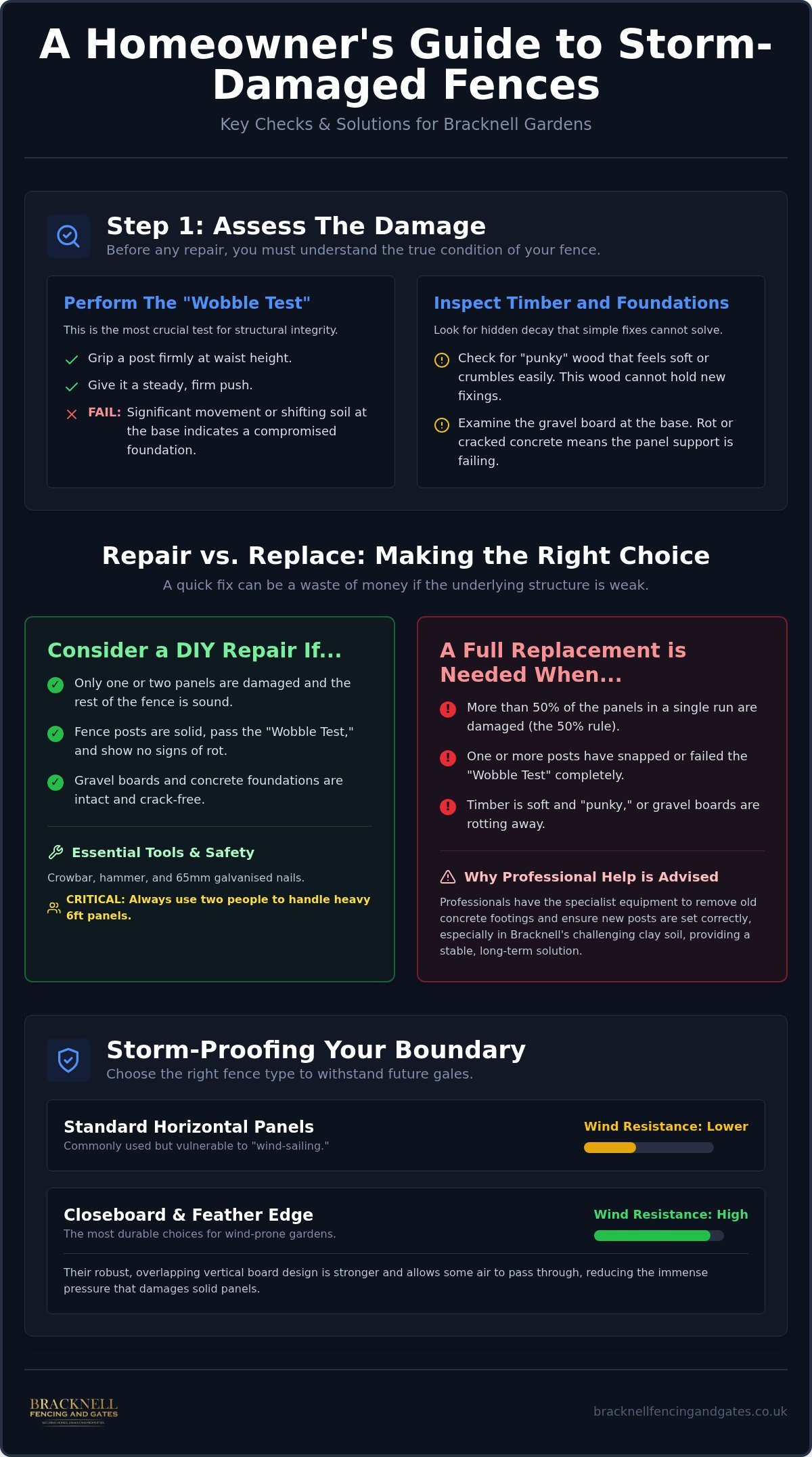
The “Wobble Test” is the most reliable way to check your fence’s integrity. Put on a pair of thick work gloves and grip a fence post at waist height. Give it a firm, steady push. If the post moves significantly at the ground level or the soil around the base is shifting, the foundation is compromised. This often happens due to “wind-sailing,” where solid panels act like sails on a boat, catching the full force of the wind and leveraging it against the post. Slatted designs or Closeboard Fencing often fare better because they allow some air to pass through, reducing the pressure on the timber.
If you find loose panels, secure them immediately. Use rope or heavy-duty bungee cords to lash them to stable posts. This prevents them from blowing away and causing injury or property damage whilst you arrange a permanent fix. Keeping the area clear of debris also makes it easier for a professional team to access the site and provide an accurate quote.
Determining Boundary Responsibility in Bracknell
Before you begin any work, check your property deeds to confirm who owns the damaged run. It’s a common misconception that you always own the fence on the left. You can find detailed guidance on this in our article: Which Side of the Fence is My Responsibility?. Once you’re certain, talk to your neighbours about the damage. If it’s a shared boundary, they might be willing to split the costs of a professional repair to restore security for both gardens.
When a Repair is No Longer Viable
Sometimes, a patch-up job is a waste of money. Check the timber for signs of fatigue or “punky” wood. If the wood feels soft or crumbly, it won’t hold nails or screws securely. You should also inspect the gravel board at the base. If the boards are rotting or the concrete is cracked, the support for the panels is gone. We generally follow the 50% rule: if more than half of the panels in a run are damaged or the posts are snapping, a full replacement is the only way to ensure the fence won’t fail again during the next storm.
How to Replace a Garden Fence Panel After Wind Damage
Replacing a single panel is a practical way to manage storm damage fence repair bracknell without the expense of a full boundary replacement. Success depends on the right preparation and a methodical approach. Before you start, gather a sturdy crowbar, a hammer, and 65mm galvanised nails. These nails are essential because they resist rust and won’t leave unsightly streaks down your new timber as the Berkshire rain sets in.
Safety is the most critical part of the process. A standard 6ft fence panel is heavy and awkward to handle. Even a light breeze can turn a timber panel into a sail, potentially causing injury or damage to your property. You should always have at least two people to lift and position the panels. This allows one person to hold the timber steady whilst the other secures the fixings, ensuring the fence stays straight and safe.
Removing the old panel requires care to avoid damaging the existing posts. Use your crowbar to gently pry the old timber away from the post. If the nails are stubborn, it’s often better to cut them with a hacksaw blade rather than forcing the wood and risking a snapped post. Once the gap is clear, check that the posts are still firm in the ground before attempting to fit the new section. If you find the posts are loose, it might be time to consider professional fence repairs to guarantee a secure finish.
Step-by-Step: Replacing a Standard Lap Panel
Install your lap panel with the vertical battens facing the inside of your garden to ensure the structural frame is protected from the worst of the elements. Using metal “U” brackets is a modern, superior alternative to traditional “toe-nailing.” These brackets screw directly into the post and the panel, creating a rigid connection that handles high winds much better. When nailing, focus your fixings through the thickest parts of the panel frame at regular 150mm intervals to prevent the timber from rattling or warping.
Finishing Touches for Longevity
Durability is the goal for any repair. Always apply a high-quality timber preservative to any cut ends or edges of the new panel to prevent rot from setting in. Ensure the panel sits on a gravel board rather than touching the soil directly. This prevents rising damp from destroying the bottom of the timber within a few seasons. Finally, use a spirit level to check the vertical alignment. A fence that looks straight is more than just a visual win; it ensures the weight is distributed evenly across the posts, making the entire run more resilient against future storms.
Repair vs. Replace: When a New Panel Isn’t Enough
A fresh panel might look great, but it’s useless if the post supporting it is failing. Many homeowners attempting storm damage fence repair bracknell discover that the real issue lies beneath the surface. Bracknell is known for its heavy clay soil, which presents unique challenges for garden boundaries. Clay expands significantly whilst wet and shrinks during dry spells; this creates movement that can loosen even the most well-set posts. Over time, this constant shifting weakens the foundation, making your fence much more vulnerable to high winds.
If a wooden post has snapped but the base is still solid, we often use concrete repair spurs. These are bolted to the existing timber and set into new concrete, providing a rigid support that bypasses the rot. However, if multiple posts are leaning or the timber is decaying throughout, switching to concrete posts is the most cost-effective long-term fix. Concrete doesn’t rot, doesn’t warp, and provides a permanent anchor against the Berkshire weather. It’s the “safe pair of hands” approach for any garden boundary. For a comprehensive look at this process, our guide on replacing wooden fence posts with concrete in Bracknell covers everything you need to know about making the switch.
Identifying Snapped Posts at Ground Level
Posts almost always rot at the “wind and water” line, where the timber meets the soil and stays damp. You’ll know a post is gone if it snaps clean off during a storm or wobbles from the base. Removing the old concrete “plug” is the hardest part of the job. It requires careful digging to avoid disturbing the rest of the garden or underground utilities. For a truly durable boundary, many local residents opt for Concrete Posts and Gravel Boards. These materials are immune to ground moisture and provide a much stronger framework for your panels.
Structural Integrity and Wind Loading
A fence acts like a large lever. When wind hits the panels, all that force is concentrated on the post at ground level. If your fence is leaning, it’s no longer structurally sound. This can be amongst the most common reasons for a total collapse during a second storm. Leaning fences are often considered a liability by home insurance providers if they fall and cause property damage. We always recommend a minimum 2-foot depth for post foundations in high-wind areas. This depth ensures the post is anchored firmly into the Bracknell clay to resist the leverage of a heavy gale.
Upgrading for Durability: Storm-Proofing Your Bracknell Boundary
When arranging storm damage fence repair bracknell, homeowners often ask how to prevent the same issue from recurring. The key is structural design. Closeboard Fencing is specifically engineered for strength; its vertical boards overlap to provide a robust barrier. Unlike standard horizontal panels that can act like a sail, the vertical orientation of Closeboard and Feather Edge panels allows for better wind resistance. These premium options use a series of individual boards nailed to horizontal rails, creating a much more stable structure than a pre-fabricated lap panel.
The role of the gravel board is equally vital. It acts as a sacrificial barrier between the timber panels and the damp Bracknell soil. By keeping the main panel away from standing water and organic matter, you significantly reduce the risk of ground rot. We recommend using concrete gravel boards for maximum longevity, as they never decay and provide a solid base that prevents pets from digging under the boundary. This simple addition ensures your new panels stay dry and structurally sound for years.
Choosing Wind-Resistant Materials
Closeboard panels are often the superior choice for surviving a Berkshire winter. While lap panels are cost-effective, they are prone to warping and blowing out under pressure. You can learn more about Why Closeboard Fencing is Bracknell’s Top Choice in our detailed guide. Always look for pressure-treated timber. This process forces preservative deep into the wood fibres, ensuring the fence remains resistant to fungal attack and rot, even in the most exposed gardens.
Planning Permission and Height Restrictions
If you decide to increase the height of your fence for better privacy or security after a storm, you must consider local regulations. Generally, a fence over 2 metres in height requires planning permission from Bracknell Forest Council. However, if your fence is adjacent to a highway or a public footpath, this limit often drops to 1 metre. It’s essential to check the Bracknell Fence Planning Permission Guide before starting any major upgrades to avoid costly enforcement notices.
Prevention is always better than a cure. Conduct annual checks by tightening loose screws and clearing debris from the base of the fence. A well-maintained boundary is far less likely to suffer catastrophic failure when the next storm hits. If you’ve noticed a lean or a loose post, don’t wait for the next gale. Contact us today for a fixed-price quote on our professional storm damage fence repair bracknell to keep your garden secure.
Professional Fence Repair Services in Bracknell: The Local Advantage
Hiring a local specialist for storm damage fence repair bracknell ensures your boundary is handled by someone who knows the area’s specific challenges. We understand how the heavy clay soil in Berkshire behaves and how the prevailing winds hit gardens in different neighbourhoods. This local insight allows us to recommend the right materials and foundation depths from the start. Instead of a generic fix, you get a boundary designed to withstand the local climate for years to come.
The use of professional equipment is another key advantage. Whilst a DIY effort might rely on manual digging, we use petrol-powered post-hole augers to reach a consistent 2-foot depth quickly. This ensures every post has a solid anchor. We also utilise industrial nail guns and galvanised fixings to provide a level of structural integrity that manual hammering simply cannot match. It’s the difference between a fence that rattles in the breeze and one that feels like a permanent part of your property.
Trust is vital after a storm. We provide fixed-price quotes to ensure there are no surprises once the work is complete. This transparency protects homeowners from opportunistic contractors who often appear after heavy gales. By choosing a methodical, local business, you gain the peace of mind that comes with a professional installation and a high standard of craftsmanship.
Our Approach to Storm Damage Recovery
Every project begins with a detailed site assessment. We don’t just look at the broken panels; we check the entire run for hidden structural issues or timber decay. We source high-quality materials including Closeboard, Feather Edge, and Concrete Posts to ensure a premium finish. Our team also handles the professional clean-up, removing and disposing of your old, broken panels so your garden is left tidy and secure.
Get a Quote for Your Fence Repair
Getting an estimate is straightforward. You can provide photos of the damage to help us give a faster, more accurate estimate before we visit. We proudly serve Bracknell, Binfield, Warfield, and all surrounding Berkshire villages. If you need a reliable, high-quality solution for your garden boundary, Contact Bracknell Fencing and Gates for a professional repair quote today.
Secure Your Garden Boundary for the Long Term
Dealing with the aftermath of a Berkshire gale doesn’t have to be a stressful experience. By accurately assessing the stability of your posts and choosing wind-resistant materials like Closeboard or Feather Edge panels, you can turn a temporary setback into a lasting property improvement. The integrity of your fence depends on more than just the timber panels; it relies on deep foundations and the right protection against ground moisture.
If you’ve discovered snapped posts or leaning sections, professional storm damage fence repair bracknell offers the most reliable path to a secure garden. As local specialists, we understand the unique soil conditions in the area and use high-quality materials to ensure your boundary stands firm. We provide transparent, fixed-price quotes so you can plan your repairs with total confidence. Don’t leave your property’s security to chance before the next weather front arrives. Request a Professional Fence Repair Quote in Bracknell today and let us provide the peace of mind you deserve.
Frequently Asked Questions
How much does it cost to replace a single fence panel in Bracknell?
The cost to replace a single panel depends on several factors, including the material chosen and the current condition of your posts. Premium options like Feather Edge panels or decorative designs may vary from standard lap panels. We also consider garden access and whether old debris requires disposal. We provide fixed-price quotes after a site assessment to ensure transparency and fair value for your storm damage fence repair bracknell.
Do I need my neighbour’s permission to repair a storm-damaged fence?
You only need permission if the fence sits directly on the boundary line or belongs to your neighbour. If your property deeds show the fence is your responsibility, you can proceed with repairs immediately. It’s always best to speak with them first to maintain good relations. If the ownership is shared, you should agree on the repair method and how to split the costs before starting any work.
Can I repair a snapped fence post without replacing the whole fence?
Yes, a snapped wooden post can often be reinforced using a concrete repair spur. This involves bolting a concrete support to the remaining healthy timber and setting it into a new concrete base. It is a cost-effective alternative to a full replacement when the rest of the fence run is still in good condition. This method provides a rigid fix that extends the life of your boundary without disturbing the entire garden.
What is the best type of fencing for high-wind areas in Berkshire?
Closeboard fencing and Feather Edge panels are the most durable options for wind-prone gardens. Their vertical construction allows wind to move more naturally around the boards compared to horizontal lap panels. When combined with concrete posts and gravel boards, these materials create a heavy, stable structure. This setup is specifically designed to resist the leverage forces that often lead to a storm damage fence repair bracknell after a heavy gale.
Is storm damage to my fence covered by my home insurance?
Home insurance policies vary, but many standard agreements don’t cover fences, gates, or hedges damaged by storms. You should check your specific policy documents or contact your provider to confirm your level of cover. Some premium policies might include boundary protection, but there is often a high excess to consider. In many cases, homeowners find that a direct professional repair is more straightforward and faster than navigating an insurance claim.
How long does a professional fence panel replacement take?
A single panel replacement usually takes between one and two hours, including the removal of the damaged section. If multiple panels or posts require attention, a small team can typically complete a standard garden run within a single working day. The exact timing depends on ground conditions and whether we need to dig out old concrete foundations. We always aim to work efficiently to restore your garden’s security as quickly as possible.
Should I choose wooden or concrete posts for my new fence?
Concrete posts are the superior choice for longevity because they are immune to rot and ground moisture. They provide a permanent framework that allows you to slide in new panels easily in the future. Whilst wooden posts offer a more natural look, they are susceptible to decay at ground level over time. For most gardens in Bracknell, concrete posts paired with gravel boards offer the best long-term resistance against the elements.
What happens if a tree has fallen on my fence during a storm?
If a tree has fallen, the first priority is to have it safely removed by a qualified tree surgeon. We don’t offer tree surgery services ourselves, but we can step in once the timber is cleared. Once the site is safe, we can assess the structural damage to your posts and panels. We’ll then provide a clear quote to rebuild the affected section of your boundary, ensuring it’s as strong as it was before.