
After a typical Berkshire storm, many homeowners in Bracknell wake up to the sight of a leaning fence or a snapped wooden post rotting at ground level. It’s a frustrating cycle that leads to frequent repair costs and unsightly damage just when you want your garden to look its best. You likely already feel that wooden posts, whilst traditional, often struggle against the damp clay soil found across our local area. Choosing the right approach for replacing wooden fence posts with concrete Bracknell wide is the most reliable way to ensure your boundary stays upright for the long haul.
In this guide, we’ll help you decide whether a full replacement or a reinforced repair spur is the best fit for your property and your budget. You’ll discover how concrete posts and gravel boards provide a durable solution that can last over 20 years without the constant maintenance of timber. We’ll also look at the practical benefits of professional installation, giving you honest advice on the cheapest long-term fixes to keep your home secure and your fence straight.
Key Takeaways
- Understand why Bracknell’s damp climate and heavy clay soil cause timber posts to rot specifically at the ground line.
- Learn the difference between a simple repair and replacing wooden fence posts with concrete bracknell to ensure a sturdy, storm-proof garden boundary.
- Discover the importance of the ‘two-foot’ rule and why professional installation is vital for handling heavy reinforced concrete materials safely.
- See how combining concrete posts with gravel boards creates a durable barrier that protects your fence panels from soil moisture and fungal decay.
- Identify the most cost-effective long-term solutions for storm damage that will keep your Berkshire garden secure for over 20 years.
Why Wooden Fence Posts Fail in Bracknell Gardens
Bracknell homeowners often discover that their garden boundaries look perfect from a distance, yet they lean precariously after a mild storm. The culprit isn’t usually the panels themselves, but the point where the timber meets the earth. Many residents eventually find themselves replacing wooden fence posts with concrete Bracknell wide because timber simply can’t withstand the local ground conditions indefinitely. Identifying failure early can save you from a total fence collapse during the next high wind event.
You can check the health of your fence by performing a simple ‘wobble test’ on each post. If the timber moves independently of the concrete base or feels ‘spongy’ at the soil level, the structural integrity is likely compromised. Look for visible signs such as dark, soft patches of rot or fungal growth amongst the base of the wood. These are clear indicators that the timber is no longer supporting the weight of your panels.
The Science of Timber Decay in Soil
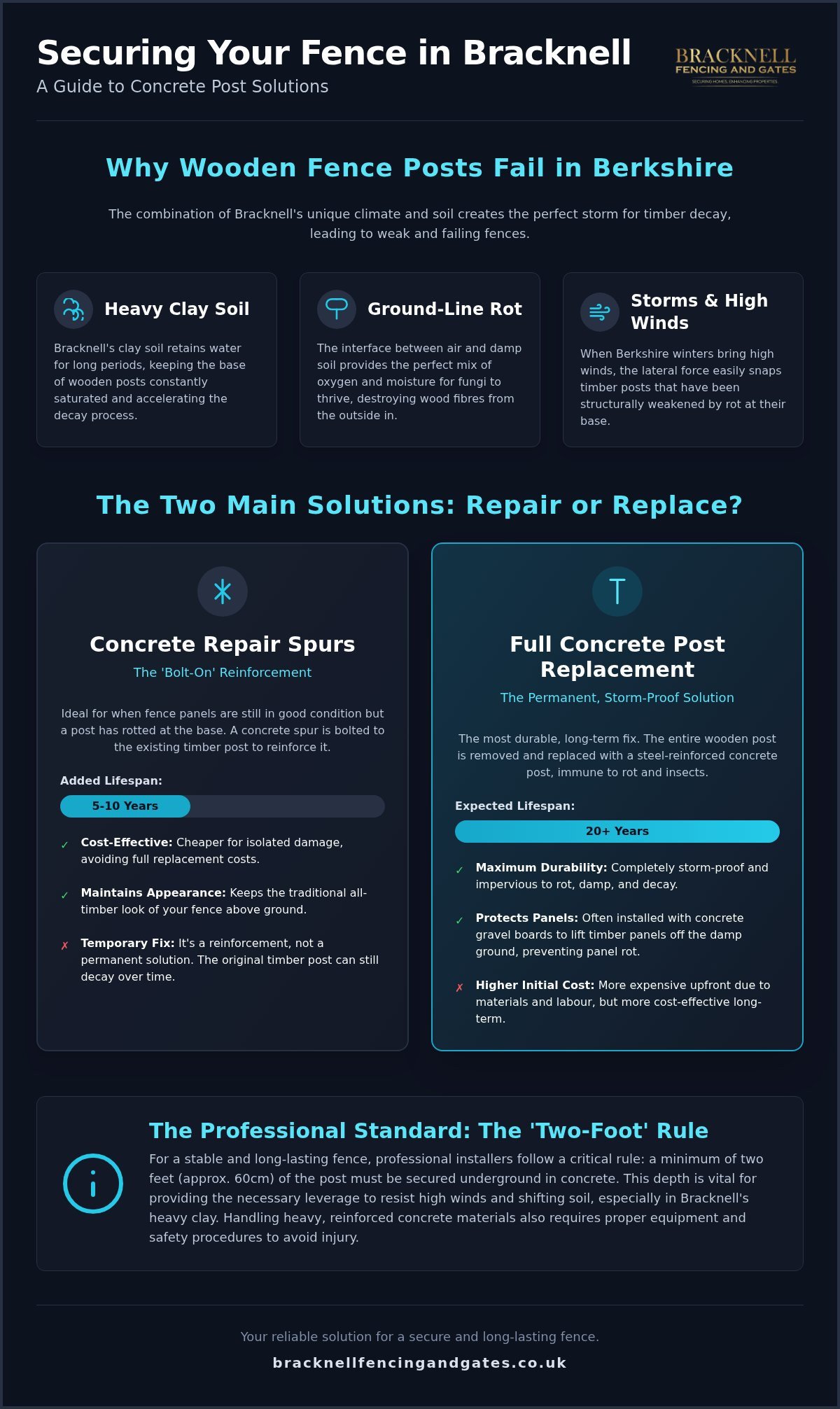
Timber decay occurs most aggressively at the surface because fungi require a specific balance of moisture and oxygen to thrive. Deep underground, there’s often too little oxygen; high above the ground, it’s usually too dry. The ground-line provides the perfect environment for these organisms to feast on wood fibres. Whilst there are different types of fencing available, most residential boundaries in Berkshire rely on timber posts that are vulnerable to this biological attack.
Even high-quality ‘UC4’ pressure-treated timber, which is designed for ground contact, eventually succumbs to the relentless moisture. Surface rot might appear minor at first, but it quickly spreads to the structural core. Once the core fails, the post loses its ability to resist the lateral pressure of the wind, making it a safety hazard for your family and neighbours.
Bracknell’s Weather Patterns and Fence Stress
The Thames Valley is known for its heavy clay soil, which holds onto water long after the rain has stopped. This persistent dampness keeps the base of your fence posts saturated for months at a time, accelerating the decay process. When we experience the typical high winds associated with Berkshire winters, these weakened posts are the first things to snap. Ground-line rot is the primary cause of fence failure in the UK.
Heavy rain also softens the ground, allowing posts to shift if they aren’t anchored correctly. This is why professional concrete fence post installers focus so heavily on the depth and stability of the footings. Protecting a closeboard fencing installation starts with the foundations. By replacing wooden fence posts with concrete Bracknell residents can bypass these weather-related headaches entirely, ensuring their boundary remains upright regardless of the season.
Concrete Spurs vs. Full Post Replacement: Which is Best?
Homeowners in Berkshire often face a choice between a quick fix and a permanent solution when a fence starts to lean. If the timber is mostly sound but has rotted at the base, you don’t always need to tear everything down. Understanding the UK timber construction guidance helps in seeing why wood eventually fails and how different reinforcement methods can extend its useful life. The decision usually boils down to your budget, your long-term plans for the property, and your aesthetic preferences.
Many residents value the natural look of an all-timber boundary. Using a concrete spur allows you to keep that traditional appearance whilst providing a stone-solid base underground. However, if you prefer a clean finish, full concrete posts provide a modern “framed” look that many find appealing. A repair spur typically adds 5 to 10 years of life to an existing post. In contrast, a full concrete post is often a 25-year investment that outlasts timber three-to-one.
Choosing Concrete Repair Spurs
Repair spurs are the ideal choice when your fence panels are still in excellent condition but one or two posts have snapped. This method is often called the ‘bolt-on’ fix. We dig a hole alongside the existing post, install the reinforced concrete spur, and secure it to the remaining healthy timber using heavy-duty coach bolts. It’s a significant cost saver for minor storm damage because it avoids the labour and material costs of a full teardown.
This approach is particularly effective for solid closeboard fences where the rails are still firmly attached. By reinforcing the base, you bypass the “ground-line” rot issue without the disruption of a full replacement. If you are unsure which route to take, our team can provide a quick assessment of your current fence repairs to see if spurs are a viable option for your garden.
Opting for Full Concrete Post Replacement
When multiple posts have failed or you are planning a completely new installation, replacing wooden fence posts with concrete Bracknell wide is the most logical step. Slotted concrete posts are the gold standard for durability. They feature a groove that allows fence panels to slide in and out easily. This design makes future panel maintenance effortless since you won’t need to pull any nails or screws to swap a damaged section.
For maximum protection, we recommend pairing concrete posts with concrete gravel boards. This combination creates a total moisture barrier between the soil and your wooden panels. It prevents the bottom of the timber from sitting in damp grass or mud, which is the leading cause of premature decay. Whilst the initial cost is higher than timber, the lack of maintenance and the extended lifespan make it the cheapest long-term fix for any Berkshire property owner.
Professional Standards for Concrete Fence Post Installers
Concrete posts are significantly heavier than timber alternatives. A single 8ft intermediate post can weigh nearly 50kg. This physical weight makes professional concrete fence post installers a necessity for most homeowners. Handling these materials requires specific lifting techniques to avoid injury and ensure the structure doesn’t lean under its own weight. Beyond the physical effort, installers must always adhere to the official fence planning permission rules regarding height and placement to avoid local boundary disputes.
Achieving a perfect vertical alignment, or “plumb”, is what separates a professional finish from a DIY attempt. We use high-accuracy spirit levels on multiple faces of the post to ensure it’s perfectly straight. This precision is vital when replacing wooden fence posts with concrete Bracknell wide, as even a slight tilt at the base becomes a major lean at the top of a six-foot panel. Using high-strength Postcrete ensures a rapid set, locking the post into its final position within minutes.
Removing the Old Wooden Post and Concrete
The first challenge in any replacement project is the “breaking out” process. Old wooden posts are usually anchored in a large mass of concrete, often called a “biscuit”. We use heavy-duty breakers to remove this old material entirely. It’s vital to clear the new hole of all old debris before starting the installation. Leaving old concrete fragments in the ground can create weak spots or air pockets that lead to future movement. We also ensure all waste materials are disposed of responsibly according to local Bracknell guidelines for construction waste.
Setting and Securing the New Post
Once the hole is clear and ready, we apply the ‘two-foot’ rule to ensure structural integrity. A standard 1.8m fence requires a minimum 600mm hole depth for safety. This depth provides the necessary leverage to resist high winds and the substantial weight of the reinforced concrete. We carefully position each post, using temporary bracing where necessary to hold it steady whilst the Postcrete is poured and mixed.
Correct orientation is critical, especially when using slotted posts. The grooves must align perfectly with the subsequent post so that panels can slide in smoothly without sticking or rattling. For closeboard fencing, the posts must be oriented so the horizontal rails can be secured firmly. This methodical approach ensures your new boundary is not only straight but also structurally sound for decades to come.
Local Considerations: Bracknell Soil and Boundaries
Bracknell’s local geology dictates how we approach every project. Much of the town sits on heavy clay soil that behaves differently than the sandy ground found in other parts of the UK. This clay holds onto moisture for long periods, creating a saturated environment that puts immense pressure on timber footings. When replacing wooden fence posts with concrete Bracknell homeowners are essentially future-proofing their boundaries against these specific local conditions. Concrete doesn’t warp or move with the soil’s moisture cycles in the same way wood does.
Sloping gardens are another common feature amongst Berkshire properties. Installing a fence on an incline requires a technique called ‘stepping’. We use longer concrete posts to ensure that each panel remains level whilst the base of the fence follows the natural contour of the land. This prevents unsightly gaps and ensures the structural load is distributed evenly across the boundary. This is particularly important for a closeboard fencing installation, where the weight of the timber requires a perfectly level and stable foundation.
Managing Clay Soil and Drainage
Clay soil’s tendency to expand and contract can lead to a phenomenon known as ‘heave’. This is where the ground literally pushes the post upwards during a freeze or heavy rain. To prevent this, we dig slightly wider holes and include a layer of hardcore or crushed stone at the base. This simple step improves drainage and creates a more stable anchor for the Postcrete. It’s a vital part of our professional standard that ensures your fence doesn’t shift over time, even during the wettest Berkshire winters.
Boundaries and Planning Permission
Before you start digging, it’s essential to know exactly where your responsibility lies. Boundary disputes are common; so we always recommend consulting our guide on which side of the fence is my responsibility uk before making permanent changes. If you’re planning a boundary over 2 metres in height, you’ll also need to check the planning permission for fence bracknell. Most residential back garden fences are capped at 2 metres, but front gardens and areas near highways have stricter limits.
Clear communication with your neighbours is the best way to avoid friction. Even if the fence is legally yours, letting them know about your plans for replacing wooden fence posts with concrete Bracknell based helps maintain good relationships. If you’re ready to secure your boundary with a permanent solution, you can view our full range of Concrete Posts & Gravel Boards to see the available styles and find a durable fit for your garden.
Reliable Fence Post Replacement in Bracknell
Choosing a local specialist for replacing wooden fence posts with concrete Bracknell wide ensures your project is handled with local knowledge and technical precision. At Bracknell Fencing and Gates, we’ve spent years perfecting the art of boundary installation across Berkshire. We don’t just put posts in the ground; we build foundations that are designed to last for decades. Our team uses only high-quality, reinforced concrete materials to provide the strength needed to withstand the unpredictable British weather.
A professional finish is about more than just a straight line. It’s about the peace of mind that comes from knowing your fence won’t lean after the first winter frost. We provide fixed-price quotes for every project, ensuring you have total clarity on costs before any work begins. There are no hidden charges for the labour of breaking out old footings or disposing of heavy waste. We believe in fair value and honest craftsmanship.
The Bracknell Fencing and Gates Difference
Our team is rooted in the local community. We understand how Bracknell’s heavy clay soil can be a challenge for some structures but a stable anchor if handled correctly. This local insight allows us to tailor our installation methods to your specific garden conditions. We take immense pride in our workmanship, treating every property with the same level of respect and attention to detail as if it were our own home.
Transparency is at the heart of our service. You’ll receive a clear breakdown of the work required, from the depth of the holes to the type of gravel boards used. We don’t use high-pressure sales tactics; we simply offer reliable advice based on years of experience in the trade amongst local homeowners. Our goal is to provide a stress-free experience that leaves you with a sturdy, attractive boundary you can be proud of.
Start Your Fence Transformation Today
Transforming your garden boundary starts with a simple conversation. We offer a straightforward contact process and provide a free, no-obligation site visit to assess your needs. When you’re considering replacing wooden fence posts with concrete Bracknell gardens benefit from a foundation that won’t succumb to fungal decay. Whether you’re dealing with storm damage fence repair bracknell or planning a full new build, we have the expertise to help.
Don’t wait for the next storm to test the limits of your rotting wooden posts. Upgrading to a concrete-supported boundary is a smart investment that eliminates the need for frequent repairs. Contact us today to see how we can secure your property with a permanent, professional solution that stands the test of time.
Secure Your Garden for the Long Term
Choosing a durable boundary is a smart investment for any Berkshire property. We’ve explored how Bracknell’s heavy clay soil accelerates timber decay and why reinforced concrete offers a permanent alternative to rotting wooden footings. Whether you opt for a cost-effective repair spur or a full slotted post installation, the result is a sturdy fence that stands up to the harshest weather. Professional installation ensures your foundations are deep enough to resist wind pressure whilst maintaining a perfectly level finish.
Replacing wooden fence posts with concrete Bracknell homeowners gain peace of mind and a boundary that outlasts timber by decades. Our local specialists are here to help you navigate boundary rules and soil challenges with ease. As an expert storm damage repair team, we focus on using high-quality reinforced concrete materials to deliver a professional, plumb finish every time. You don’t have to settle for a leaning fence or frequent repair costs.
Request a fixed-price quote for your concrete post replacement today and take the first step toward a maintenance-free garden. We look forward to helping you build a fence that truly stands the test of time.
Frequently Asked Questions
Is it cheaper to replace wooden posts with concrete or just repair them?
Repairing with concrete spurs is the most cost-effective solution for minor damage, but full replacement is the cheapest long-term fix. A spur reinforces a single snapped post without disturbing the whole line. However, if your fence is over a decade old, replacing wooden fence posts with concrete Bracknell wide is a better investment. It prevents the need for recurring labour costs every time another timber post succumbs to ground-line rot in the Berkshire rain.
Can you put concrete posts in an existing fence line?
Yes, we can install concrete posts into an existing fence line provided the panels are standard widths. This process involves carefully removing the old timber and its concrete base before positioning the new reinforced post. It’s a common request for homeowners who want to upgrade their boundary piece by piece. We ensure the new posts align perfectly with your remaining fence to maintain a straight, professional look across your garden boundary.
How long do concrete fence posts actually last compared to timber?
Concrete fence posts typically last 25 years or more, significantly outperforming standard timber. In the damp Berkshire climate, wooden posts often fail within 5 to 10 years due to fungal decay. When replacing wooden fence posts with concrete Bracknell residents benefit from a material that is entirely resistant to rot and moisture. Whilst the initial installation requires more effort, the extended lifespan means you won’t have to worry about your fence for decades.
Do I need to replace my fence panels if I switch to concrete posts?
You don’t always need to replace your panels when switching to concrete posts if they are still structurally sound. Slotted concrete posts are designed to work with standard 6ft wide panels, including feather edge and closeboard varieties. If your existing panels are a non-standard size or have begun to rot, it’s often more efficient to replace them at the same time. This ensures the entire boundary has a uniform, high-quality appearance and maximum durability.
Will concrete posts make my garden look like a car park?
Modern concrete posts provide a clean, framed aesthetic that many Bracknell homeowners find quite attractive. They offer a sense of permanence and security that timber sometimes lacks. If you’re worried about a harsh look, you can soften the appearance by choosing decorative fence panels or using climbing plants. The grey tone of the concrete also provides a neutral backdrop that makes the green colours of your garden plants stand out more vividly.
How deep do you dig the holes for concrete posts in Bracknell clay?
We dig holes to a minimum depth of 600mm, or two feet, for a standard 1.8m high fence. This depth is essential in Bracknell’s heavy clay soil to provide a stable anchor against wind leverage. Because clay expands and contracts with moisture, a shallow hole would eventually lead to a leaning fence. We also use a layer of hardcore at the base to improve drainage, ensuring the post remains secure through every season.
What happens to the old wooden posts and concrete after the job?
Our team takes full responsibility for removing and disposing of all waste materials from your property. This includes the old rotten timber posts and the heavy concrete biscuits that anchored them in the ground. Disposing of these materials responsibly is part of our professional service. We ensure that your garden is left tidy and that all construction waste is handled according to local Bracknell guidelines, saving you the hassle of a trip to the tip.
Do I need planning permission to change my wooden posts to concrete?
You generally don’t need planning permission to change the material of your fence posts from wood to concrete. The primary rules concern the height of the boundary rather than the materials used. In Bracknell, you can usually install a fence up to 2 metres high in a back garden without permission. However, if your fence is over 1 metre high and adjacent to a highway or footpath, you should check with the local council first.